
These days the favourite sound bite of politicians opposed to Scottish independence is that the 2014 referendum was a “once in a generation” event. They tell us that means that there should not and cannot be another for at least another decade or two.
This is a profoundly anti-democratic stance to take. Effectively those who espouse this argument are saying that the electorate should be deprived of any means to hold the winners of the 2014 referendum to account – while at the same time they insist that the losers must respect the result. Yet really, it’s more important that it’s the winners of a vote who must respect the result, by respecting the promises and commitments that they made in order to win the vote. Democracy can only function if the electorate are able to hold the winners of elections to account. Those who won the referendum of 2014 are seeking to deprive the people of Scotland of any means of holding them to account for their failure to abide by some of the key promises and commitments that were made by the Better Together campaign to keep Scotland within the UK, not the least of which was the claim that it was only by voting no that Scotland could remain a part of the EU.
Both Alex Salmond and Nicola Sturgeon were clear that they were offering personal opinions when they described the 2014 referendum as a “once in a generation opportunity”. There certainly was no firm commitment on their part that the question should never be put to Scotland again until the present generation has died off. What was really meant by the phrase was that the vote in 2014 only came about because of the unprecedented circumstances of an SNP majority in a parliament and voting system which was designed to produce minority governments.
There was nothing in the Edinburgh Agreement about it being a “once in a generation” vote. It was the Edinburgh Agreement which set the political parameters for the referendum. If the referendum really was intended to be a once in a generation affair, you’d imagine that this crucial document might have mentioned that fact. Equally there was nothing on the ballot paper to suggest that it was a “once in a generation” vote. I voted in that referendum, the question was “Should Scotland become an independent country?” not “Should Scotland become an independent country and if the result is no then do you agree to surrender your right to ever have the question asked again in your lifetime?”
In the white paper Scotland’s Future, Your Guide to an Independent Scotland, which was published by the Scottish government in the run up to the referendum of 2014, there are two mentions of the phrase “once in a generation opportunity”. On page 3 it says “If we vote No, Scotland stands still. A once in a generation opportunity to follow a different path, and choose a new and better direction for our nation, is lost.” On page 10 it describes the referendum as “a once in a generation opportunity to chart a better way.” Note the exact words there, “once in a generation opportunity”, not “once in a generation referendum”.
Those are the only two mentions of the phrase in the White Paper, both came in the introduction. Nowhere in the document is an explicit commitment that there will only be another referendum after a generation has passed, for two reasons. Firstly because those who wrote the document were hoping for a yes vote, in which case a second referendum is moot. Secondly and more importantly it’s because the phrase was never intended as a political promise. It was a description of the perceived likelihood of there being another SNP majority government in Holyrood.
It is widely known that the voting system used for Holyrood elections is designed to produce minority governments which require coalition partners. This was the result of a deal done behind closed doors between Labour’s Donald Dewar and the Lib Dems’ Menzie Campbell. The plan was that Holyrood would in perpetuity be governed by a coalition of Labour with the Lib Dems. It was designed to freeze out both the SNP and the Conservatives. And the plan worked well enough for the first ten years of the parliament. The SNP won a minority victory in 2007, much to Labour’s chagrin. Labour was expected to win the election of 2011, but much to everyone’s surprise, including the surpise of the SNP leadership, the SNP didn’t only manage to win the election, it managed to win an outright victory with a majority of Holyrood seats. No one had ever expected such an outcome to be possible, and reports in the aftermath of the election described the SNP as having broken the system.
This is the context in which the “once in a generation” comment must be understood. No one in the SNP expected the party to win an outright majority in 2011, and before that election no one had believed that the party would be in a position to deliver its promise to hold an independence referendum.
Remember that all this was taking place before the referendum of 2014 broke the mould of Scottish politics forever. The SNP, and just about everyone else back then, believed that losing the referendum would see the end of the SNP’s independence plans, and would most likely result in the party failing to remain the largest party after the next Holyrood election, never mind securing an absolute majority. It was believed that the independence referendum was only possible because of the highly unusual circumstances of the SNP’s shock majority victory in the election of 2011, a set of circumstances which were thought to be unlikely to be repeated any time soon.
The only reason that this “once in a generation” statement has become a political issue now is because there is a demand for another vote, there is a majority in Holyrood for another vote, and because that vote is highly likely to produce a yes result. Opponents of independence know that their best hope of preventing independence is to prevent the question ever being asked, and they will grasp at any straw that helps them to do so, no matter what damage it does to the fabric of Scottish democracy. They know that the people of Scotland will not judge them kindly for their failure to live up to the promises and commitments that they made to Scotland in order to secure a No victory in 2014. When politicians cannot be held to account for their failure to abide by their promises, democracy dies.
But even if it were the case that there was a firm commitment that the 2014 was “once in a generation”, so what? If a Westminster government cannot bind its successors, then why should that same rule not apply to Holyrood? If circumstances change then another referendum is perfectly justified, indeed it becomes a democratic necessity. Democracy is not an event, it’s an ongoing process. A democracy which refuses to acknowledge the right of the people to change their minds when circumstances change is no democracy at all.
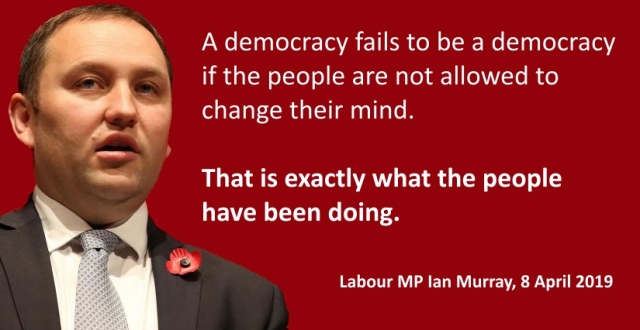
Labour MP Ian Murray, that’ll be the Ian Murray who is currently banging on about how the referendum was “once in a generation”, said on Channel 4 news on Wednesday evening that there shouldn’t be another independence referendum because the people had spoken in 2014. Then he asserted that there definitely ought to be another EU referendum because the first had been won on fear and lies. Sauce for the goose, meet sauce for the gander. This is also the Ian Murray who told the House of Commons on 8 April 2019, “A democracy fails to be a democracy if the people are not allowed to change their mind. That is exactly what the people have been doing.” Indeed Ian, indeed. And they don’t need to take a generation to do so.
 My new book has just been published by Vagabond Voices. Containing the best articles from The National from 2016 to date. Weighing in at over 350 pages, this is the biggest and best anthology of Wee Gingerisms yet. This collection of pieces covers the increasingly demented Brexit years, and the continuing presence and strength of Scotland’s independence movement.
You can order the book directly from the publisher. Ordering directly means that postage is free. You can order here –
https://www.vagabondvoices.co.uk/rants/barking-up-the-right-tree-2019
You can also order a book directly from me. The book costs £11.95 and P&P is an additional £3.50, making a total of £15.45. To order just make a Paypal payment to weegingerbook@yahoo.com, or alternatively use the DONATE button below. Please make sure to give me your postal address when ordering. Orders to be sent outwith the UK will incur extra postage costs, please email me for details. If you can’t use Paypal, or prefer an alternative payment method, please email weegingerbook@yahoo.com
You can help to support this blog with a Paypal donation. Please log into Paypal.com and send a payment to the email address weegingerbook@yahoo.com. Or alternatively click the donate button. If you don’t have a Paypal account, just select “donate with card” after clicking the button.
If you have trouble using the button, or you prefer not to use Paypal, you can donate or purchase a t-shirt or map by making a payment directly into my bank account, or by sending a cheque or postal order. If you’d like to donate by one of these methods, please email me at weegingerbook@yahoo.com and I will send the necessary information.
Please also use this email address if you would like the dug and me to come along to your local group for a talk.
 Gaelic maps of Scotland are available for £15 each, plus £7 P&P within the UK for up to three maps. T-shirts are £12 each, and are available in small, medium, large, XL and XXL sizes. P&P is £5 for up to three t-shirts. My books, the Collected Yaps Vols 1 to 4 are available for £11 each. P&P is £4 for up to two books. Payment can be made via Paypal.
