



We’ve still got a few of the results from our last Panelbase poll (conducted last month) to round up, and this one seems pertinent this week:
As it has been ever since we started asking this question about the nation’s twin constitutional dilemmas back in July 2015, the single most popular option in a four-way choice remains an independent Scotland inside the EU, which leads the impending reality (a UK Scotland outside the EU) by a clear 10 points.
Scotland isn’t merely about to get something it doesn’t want, it’s about to get the exact opposite of the thing it wants most. But oh boy, is it ever more complicated than that.
Those headline numbers have barely changed in four years, with one exception. We asked the question in 2015, 2016 (in September, after the EU referendum), 2017 and 2019, and the figures for each option have been these:
INDY+EU: 32, 32, 31, 32
UK+EU: 31, 28, 26, 30
UK+BREXIT: 15, 24, 27, 22
INDY+BREXIT: 11, 11, 10, 8
We’re not sure we can explain the leap in support for the “UK plus Brexit” option since the EU referendum, other than on democracy grounds. There’s been absolutely no increase in support for Brexit in Scotland – most polls show the opposite – so we can only reasonably assume that it’s a reflection of people thinking the referendum result should be enacted even though they don’t like it, because there’s been no actual material change or political mandate to contradict it.
(Both main UK parties campaigned in the 2017 election on a promise to carry out Brexit and got around 85% of the vote between them. The situation is entirely different to that with Scottish independence, where a party pledging a second referendum won an election and where the Parliament passed a motion upholding that pledge by a clear majority.)
Meanwhile what we might call the “extreme independence” faction, which wants a divorce from both London and Brussels, has reached its lowest ebb, dropping by almost a third since 2015 and 2016.
Interestingly, the gender gap which people used to blame on the personality of Alex Salmond has made a notable return:

Despite the gender-balanced cabinets of Nicola Sturgeon and the work of much-lauded groups like Women For Independence, the women of Scotland now prefer the status quo option by 31-28, whereas men favour independence by 35-29, a significant nine-point margin between the sexes.
The generation gap, though, is considerably more dramatic.

By an ENORMOUS gulf, Scotland’s youngest voters, the 16-34 age group, want to live in an independent EU member state. Indeed, if we exclude Don’t Knows then they’re an absolute majority (53%) even in a four-way question, with young people extremely against either variant of Brexit.
The middle age group slightly prefers the current status quo (due to come to an end by this October) to independence in Europe, while the elderly would actually choose Brexit with the UK, with the status quo as their second preference and independence a distant third. Scotland’s grandparents, parents and children are now all at war with each other.
Within those age groups, however, the gender gap looms large again. For 16-34s, men prefer independence in Europe by a colossal margin of 32 points over any other option (54% versus 22% favouring the status quo), but for young women it’s just 13 points (43-30).
For over-55 men the numbers are fairly tight – the status quo leads by just three points over UK+Brexit and another five points over indy+EU (33-30-25). It’s Scotland’s old women who favour Brexit, with a clear eight-point lead over UK+EU, and another 10 points over indy+EU (36-28-18).

The nation is divided by social class too:
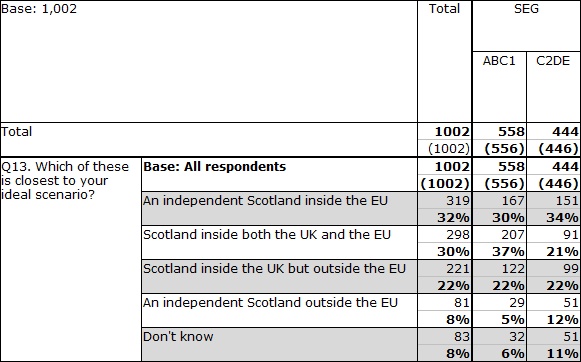
Scotland’s wealthier ihnabitants prefer the status quo, unsurprisingly (given that it’s made them wealthy), but more interestingly they prefer independence in the EU to Brexit by some distance. The poor, meanwhile, back independence by a whopping 13 points, with a UK Brexit in second place marginally ahead of the status quo, and are the only demographic other than young voters where the combined independence options outscore the combined UK options (45 to 43).
And we may as well also do it by party allegiance:

The most interesting thing there is that both Labour voters (by a huge margin) and Lib Dem voters (by the smallest margin possible) prefer independence to Brexit, with more than a quarter of 2017 Labour voters having indy as their first choice.
In total, a thumping 38% of Labour voters want some sort of Scottish independence as their ideal choice, which (a) makes the Scottish party’s fanatical resistance to it even more politically idiotic, and (b) does rather cause one to wonder what on Earth those people were thinking by voting Labour anyway.
And screw it, let’s get the football in there too.

Celtic and smaller clubs’ fans both go for indy with the status quo in second place (but with dramatically different numbers – Celtic fans are a huge 60% for some form of indy compared to just 39% of the smaller-club supporters), New Rangers fans are a dead heat but also with much higher Brexit backing, and football-haters want the status quo with Brexit as their next-best option.
So let’s just recap those first preferences:
ALL SCOTS: Independence in the EU
MEN: Independence in the EU
WOMEN: UK in the EU
YOUNG PEOPLE: Independence in the EU
MIDDLE-AGED PEOPLE: UK in the EU
OLD PEOPLE: UK Brexit
WEALTHY PEOPLE: UK in the EU
POOR PEOPLE: Independence in the EU
YOUNG MEN: Independence in the EU
MIDDLE-AGED MEN: UK in the EU
OLD MEN: UK in the EU
YOUNG WOMEN: Independence in the EU
MIDDLE-AGED WOMEN: UK in the EU
OLD WOMEN: UK Brexit
SNP VOTERS: Independence in the EU
LABOUR VOTERS: UK in the EU
LIB DEM VOTERS: UK in the EU
TORY VOTERS: UK Brexit
CELTIC FANS: Independence in the EU
“RANGERS” FANS: Independence/UK in the EU
SMALL CLUB FANS: Independence in the EU
NON-FOOTBALL FANS: UK in the EU
Well, that’s a mess, isn’t it? Nine each for independence in the EU (for which there’s no power to hold a vote) and UK in the EU (for which there’s no democratic mandate), three for a UK Brexit (the thing that’s actually currently going to happen) and one tie.
We’re tired, folks. Who’s up for just agreeing to toss a coin for it and then never talk about any of this ever again?


