



After three days of torture by police officers in the Mexican state of Puebla, Primo Villalva Domínguez, a farmer and member of the Independent Peasants Union, signed a confession to a kidnapping of which he insists he is innocent.
“They beat me and I now have a curved spine and I’m deaf in one ear”, Villalva explains from inside the prison, referring to the torture he experienced at the hands of state police almost 20 years ago.
“At four in the morning they said to me: ‘We’ve got your brother and your nephew. If you don’t sign this confession, we’re going to charge them along with you´. Being so badly beaten and humiliated, I signed it. But they were papers which they had drawn up themselves,” he explains.

Now 66 years old, he is nineteen years into a 30 year sentence in San Miguel state prison in Puebla, an hour south of Mexico City. He is one of 200 prisoners throughout Mexico viewed by supporters as political prisoners.
While Villalva Domínguez says he is victim of torture and a miscarriage of justice, he is considered by activists as a ‘prisoner for political motives’ due to his continued membership of the Unión Campesina Independiente (UCI), a peasant’s union which campaigns for the rights of poor, often-indigenous Mexicans.
A tribute to Mexico’s disappeared amidst demands for the truth
The number of political prisoners has fluctuated in Mexico, explains Francisco Cerezo, head of Comité Cerezo, an advocacy group calling for, among other things, the liberation of all political inmates and prisoners of conscience.
Higher profile prisoners were released at the start of Andrés Manuel López Obrador’s presidency in late 2018.
A statement to The Ferret from the office of the federal government’s undersecretary of human rights said the release of 47 political prisoners had been achieved by López Obrador’s government, including water, land and environmental activists.
The statement referred to “political prisoners or victims of reprisals from local political bosses, officials or rulers of the former authoritarian regime”.
The statement added that the Interior Ministry´s justice system support unit has received 1,221 requests – 236 at a federal level and 985 at a local level – to review cases of possible political prisoners, people unjustly imprisoned as a result of a lack of due process, as well as indigenous prisoners.
“With these actions, the new government breaks with the repressive policy of the old regime, and inaugurates a new stage of democratic construction in the country”, the federal government statement concluded.
Those without prominent campaigns and networks of solidarity, however, have remained imprisoned, Cerezo says.
“They’re the ones who are left behind in prison. There are some who have been in prison for 15 or 20 years, and now pretty much have no options left to achieve their freedom”, he adds.
Extrajudicial killings
While it is true there are no longer prisoners for political motives at a federal level, around 200 are imprisoned for political reasons at a state level, he argues.
The number of political prisoners also declined for more deadly reasons after the start of former president Felipe Calderón’s ‘war on drugs’ in 2006. Since then more than 250,000 people have been killed and over 60,000 people have disappeared, Cerezo says.
“The political cost of making someone a [political] prisoner was higher than that of executing them,” say Cerezo. “If they died, ‘they were involved in something, they were a drug trafficker, they were connected to organised crime’. And many human rights defenders were executed.”
Enlarge
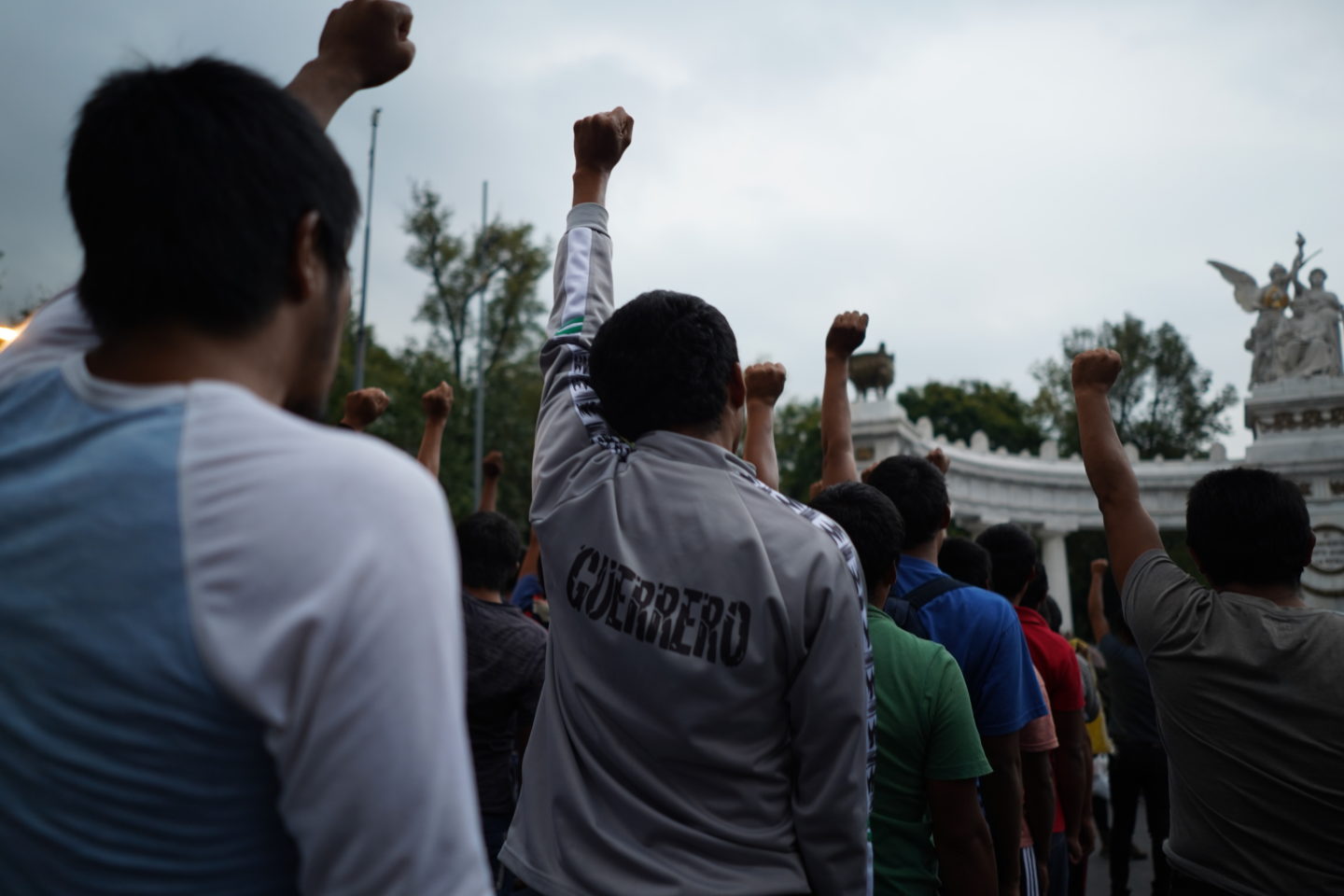
A Mexico City demonstration in support of the 43 students kidnapped from Ayotzinapa in 2014.
Following on from Calderón, extrajudicial killings – murders by agents of the state – reached unprecedented levels under the presidency of Enrique Peña Nieto, between 2012 and 2018, he adds.
The most high-profile case was the forced disappearance in 2014 of 43 students from the Ayotzinapa rural teacher training college, an institution with a long history of grassroots, left-wing activism. This was reported by The Ferret in 2015.
An official report confirmed what many long suspected: municipal police officers ambushed and shot dead several students, before kidnapping the others and handing them over to a local crime group, where they were ‘disappeared’.
Amnesty law
To mitigate the risks of Covid-19 sweeping through overcrowded and often highly-unsanitary prisons, the Mexico Government signed an amnesty law on 20 April this year which aimed to release thousands of prisoners convicted of non-violent crimes, in failing health, old age or who are nearing the ends of sentences.
This glimmer of hope for Villalva Domínguez and other political prisoners was quickly extinguished, however, as it became apparent the amnesty would not apply to those classed by advocacy groups as prisoners for political motives.
To date, the law hasn’t been applied to any prisoner, political or social, as the commission required to review and process applications for amnesty hadn’t been established. On Thursday 18 June the federal government finally announced the creation of the commission, two months after signing the amnesty law.
More generally, an unwillingness on the part of authorities to address the issue of political prisoners means Villalva Domínguez, and an estimated 200 other political prisoners in Mexico, have remained locked up, despite campaigners calling for their immediate release.
The Ferret contacted the federal government for comment on the delay to implement the amnesty law, and the scope of its application, but no response was given by the time of publication.
We’re four in our room, but there are some that are in dormitories of 12 or 13 people
Primo Villalva Domínguez
In the exercise yard of San Miguel prison only around ten out of 100 prisoners wore face masks, Villalva observed, despite rising Covid-19 cases. He has his own mask, he explains, but had to buy it himself, as did many others.
Villalva says that he continues to share a cell with three others. He is one of the “lucky” prisoners. “We’re four in our room, but there are some that are in dormitories of 12 or 13 people,” he explains.
San Miguel prison is far from exemplary. It was raided in March by 2000 state police and National Guard troops and the prison governor was removed from his post, following consistent allegations of corruption and collusion with criminals.
Puebla is also the state whose governor, Miguel Barbosa Huerta, claimed in March that Covid-19 only affects the rich, as the poor are “immune”.
Such a belief may explain the lack of precautions being taken to protect prisoners, political and otherwise, from a Covid outbreak. The overwhelming majority of Mexico’s prisoners, political or social, come from the 40 percent of the country’s population who live in poverty.

While Villalva and his comrades in Puebla have currently not become infected with coronavirus, the situation appears particularly bleak for political prisoners in the southern state of Chiapas.
“Human rights violations haven’t been suspended because of the pandemic”, states Pedro Faro, director of the Fray Bartolomé de las Casas Centre for Human Rights (Frayba) in Chiapas.
Perhaps most well known internationally as the home of the indigenous revolutionary movement the Zapatistas, several prisoners in the state are currently protesting the lack of care received during the COVID pandemic.
At least one prisoner, Marcelino Ruiz Gómez, has sowed his lips together and began a hunger strike. He was protesting at what he and his supporters say are inhumane and unsanitary conditions, while calling for the released of indigenous prisoners.
The Frayba human rights centre has accused the state government of Chiapas of widespread, systematic failures to protect the human rights and health of political prisoners, alleging failures to test at-risk prisoners for Covid or provide the necessary health care for those with suspected cases of the virus.
Faro explains that some prisoners began hunger strikes to demand their cases are reviewed and to denounce the conditions in the prison system.
“Lack of medical care, being denied water or food, or being given rotten food, as well as abuse,” he says, listing off concerns. “But their main demand is that they are freed.”
The director of the human rights centre also stressed that while not all are political or politically motivated prisoners, a huge number are the victims of miscarriages of justice.
“All of their cases follow the same pattern: they were tortured and forced to sign incriminating statements”, Faro claims.
From the forced confession under torture Villalva alleges he gave two decades ago, to the cases of Ruíz and other prisoners in Chiapas, torture of suspects by Mexico shows no signs of abating.
A 2019 Human Rights Watch report details the systematic use of torture by Mexican authorities to obtain confessions which are then used in trials.
All of these prisons, from our point of view, are places of extermination, not of social rehabilitation. They’re a type of concentration camp, where there’s a demoralisation and a negation of of the individual.
Pedro Faro, Fray Bartolomé de las Casas Centre for Human Rights
Faro describes what he calls a “Kafkaesque process”, claiming investigators routinely use to torture to obtain confessions from innocent people, identification parades are rigged and prosecutors from across the state trade suspects who match particular descriptions.
He is blunt in his assessment of the situation for prisoners like hunger striker Ruiz in Chiapas’s prisons: “He’s a victim of the system. All of these prisons, from our point of view, are places of extermination, not of social rehabilitation.”
“They’re a type of concentration camp, where there’s a demoralisation and a negation of of the individual,” the human rights defender adds.
“They’re wrapped up in a perverse system, where they’re kept subdued, imprisoned and kidnapped by the state.”
Representatives of the Chiapas state government did not respond to requests for comment.

