



For how long, wonders Alan Dick, can you stare at four walls before they start closing in?
Seven years ago, he says, he had a life. As a wheelchair user with cerebral palsy Dick went to a day centre three days a week, and with his 59 weekly hours of social care in place was always out and about, mixing with people from all walks of life. A campaigner with Glasgow Disability Alliance (GDA) he knows about people’s rights and was always fighting to make sure disabled people got them.
Then came changes to the way his social care package was delivered. Now 63, and sitting in this ground floor flat where the clock ticks and the view out of the front window is of a brick wall, Dick claims he is not living. He is just existing.
This is #JustSurviving. A collaboration between The Ferret and HuffPost UK looking at the impact of the government’s austerity policy in Scotland.
This Glaswegian tracks back his increased isolation to a reassessment in the make-up of his social care package in 2012. His Health and Social Care Partnership (HSCP) funded hours were cut almost in half and though they were increased from 24 to 34 hours in 2017, it was at the cost of one day at the Junction 52 day centre. As a result Dick says his world has contracted, with increasing amounts of time spent sitting in this room with daytime TV for company. “There is nothing more depressing,” he says.
He can’t access the toilet without support to get out of his wheelchair but his Health and Social Care Partnership (HSCP) funded hours stretch to support staff in the morning and tea time only, provided by carers he employs through self-directed support. Several times staff shortages have meant he had to sleep sitting up in his wheelchair in soiled clothing.
Overnight support is important to him, and fortunately paid for by the Independent Living Fund (ILF), which campaigners have described as “a beacon of hope” for social care in Scotland. The fund also provides eight hours of social support a week. But Dick still feels he has unmet needs.
A reassessment has been requested from Glasgow City Council but the council insists it already provides an appropriate number of hours for his needs. It advises hours could be better used, and claims employing council care workers would solve the issues of staff shortages.
From his perspective it seems it while it was once understood that disabled people like him need adequate support, it now needs spelled out. “You need it, same as you need air to breathe,” he says.
Enlarge
Some will benefit from the introduction of Frank’s law last April, which saw free personal care rolled out to all adults (Scotland alone in the UK already offered this to over 65s).
It followed years of campaigning by Amanda Kopel the wife of Dundee footballer Frank Kopel, who was diagnosed with dementia at 59 but didn’t qualify for care. But as Dick was already only paying what he can afford – and his package is worth far more – it is unlikely that he will be better off.
“I’ve ended up with depression,” he says. “I’ve ended up feeling suicidal. When I’m in the house just looking at four walls there’s nothing to think about, other than I’m fed up with this. You’re still stuck in the same hamster wheel, going round and round. It’s an existence, not a life.”
Increasingly Glasgow City Council suggests “economic realities” – long years of austerity, combined with rising need and an ageing population – mean family and friends must step-up and do more for those in need of social care. But Alan’s family are not able to help.
Disability campaigners are now claiming this is a system is creaking. In 2016 the United Nations highlighted the brutal effects of UK welfare reform in the name of austerity was found to have systematically violated the rights of disabled people. Of the tens of billions cut to social care it is estimated that about half directly impacted disabled people.
In a previous investigation The Ferret found Scotland’s poorest communities have been hit hardest by cuts to disability benefits with over £56 million lost in annual payments. Six out of ten worst hit constituencies are in Glasgow.
GDA’s Rights Now! Project, helping people access the benefits they are entitled to won back more than £800,000 for its disabled clients in its first year alone. Though Glasgow City Council doesn’t have a break-down for disabled people it says support given through it’s Universal Credit hubs have led to financial gains of £15.2m for people entitled to benefits.
But the death-by-a-thousand-cuts effect of contracting social care budgets often remains under the radar. Convention of Scottish Local Authorities (COSLA) figures show that between 2013-14 and 2019-20 ring fenced funding has been reduced across Scotland. In Glasgow this equates to £270 per head.
The city, which is Scotland’s largest local authority, is struggling to balance the books. Papers to the Integration Joint Board, which oversees the city’s Health and Social Care partnership, reveal “potentially contentious” plans to make £4.2million of “care savings” from the 2019/20 budget by relying more on families and carers. Glasgow City Council says it is modernising the system and an underspent of £8.5m has now been reallocated, allowing the HSCP “to pursue a step change”.
There are plans to replace overnight support with telecare and increased use of shared living arrangements. The council says “difficult choices” are unavoidable due to “the economic realities of the health and care system”.
Over the last ten years social care budgets have been radically hit. What that has meant for disabled people is they are less likely to get the social care package that reflects what they actually need to live their lives.
Tressa Burke, Glasgow Disability Alliance
Last week GDA sent a chilling briefing to the council’s Integrated Joint Board to express its “grave concerns”. It read: “The reality of austerity has meant huge cost saving pressures on our social care systems, which in Glasgow has created a rhetoric of inevitability – that there can be no alternative to the cuts or the fact that disabled people can no longer expect to secure the support they need to remain in their own homes and live independent lives.”
The membership organisation, run by and for disabled people, claimed “their hard won rights to independent living, enshrined in the United Nations Convention on the Rights of Persons with Disabilities (UNCRPD), have been eroded”.
Tressa Burke, chief executive of the organisation, says: “Over the last ten years social care budgets have been radically hit. What that has meant for disabled people is they are less likely to get the social care package that reflects what they actually need to live their lives.
“Between the increase in need and demand, the cuts to social care packages, the rise in [care package] thresholds – meaning that you have to have far, far more severe impairments to get the social care packages – compounded by austerity and welfare cuts…It’s been a perfect storm affecting the lives of disabled people.”
There are positive moves on the horizon. The Scottish Government is working on social care reform policies and GDA has formed a social care expert group, who are helping advise.
“The problem is bigger than just Glasgow City Council aren’t funding disabled people’s social care,” she says. “That would be a really easy criticism to make, but it wouldn’t be fair.
“This is the biggest local authority in Scotland with the highest level of need and the highest number of disabled people. You can imagine the challenges are just staggering in Glasgow. But we do need to be able to have honest conversations about how it is and what we do next.”
Part of the problem, she argues, is the problems facing disabled people are so invisible. “We need to be starting to have those conversations,” she says. “I think people who are very far removed from the lives and the experiences of disabled people genuinely don’t understand that they can’t always make the most basic choices.”
There’s also always that kind of threat that what I’ve got could be taken away. Worse case scenario, if my support was withdrawn completely, then I don’t think I’d be able to continue to live independently.
Susan McKinstery
Just past Glasgow’s Charing Cross, the throb of the city traffic still audible, Susan McKinstery is up and dressed, has had breakfast in her bright, colourful flat and fed the cats. But her partner Maria Quinn, who is also disabled and now uses a wheelchair, will still be in bed for several hours until her carers arrive at 12.30pm to help her get up and ready for what’s left of the day.
McKinstery, now 37, has Spina bifida and has used a wheelchair most of her life. Her days are full – she’s a board member of mental health charity Flourish House, where she also does some paid sessions, she volunteers for a welfare rights organisation, is a member of a local writers group and enjoys watching movies with Maria. Their flat is covered in their favourite quotes from films.
Though her support package for basic housework tasks – reduced from 5.5 to 3 hours a week in recent years – might not seem much, to her it is essential
Her needs – in terms of mental health rather than physical issues – can fluctuate but she feels she is having to fight for a reassessment she is entitled to.
“You’re almost made to feel guilty for asking for what you’re entitled to because there are limited resources,” she says. “So it’s almost that feeling of, how dare I ask for better because I kind of manage?
“There’s also always that kind of threat that what I’ve got could be taken away. Worse case scenario, if my support was withdrawn completely, then I don’t think I’d be able to continue to live independently.”
Enlarge
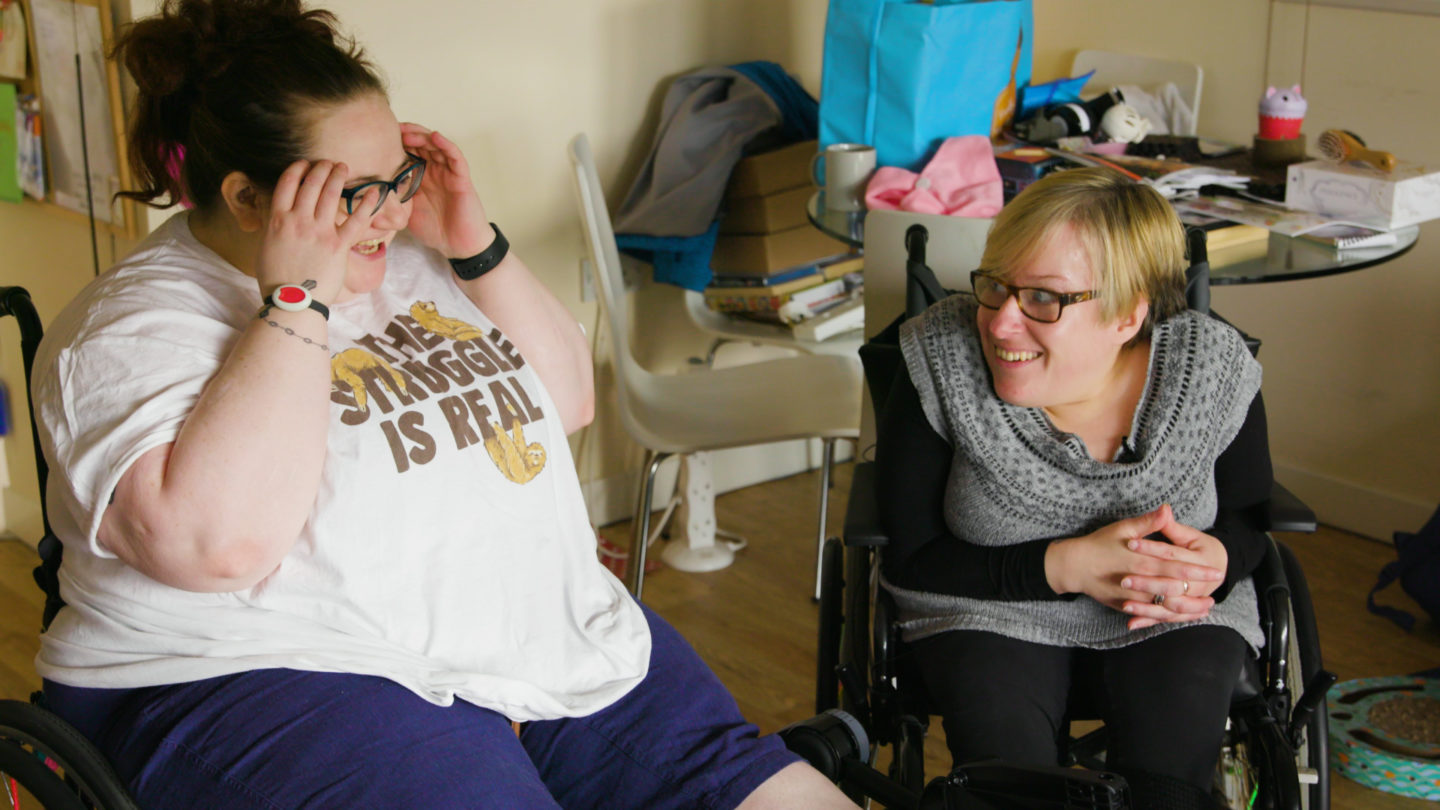
In the hall a key turns in the lock – Quinn’s carer is here – and a while later she wheels herself into the living room with a twinkly smile, joking about her T-shirt. “The struggle is real,” it says. And though she’s upbeat, it often is, she admits. She has CRPS- complex regional pain syndrome, and has struggled with her much reduced mobility since leaving hospital earlier this year.
“I have a panic alarm because if I fall I can’t get up any more,” she says. Two days a week she has sufficient hours for a carer to help her shower. “But if I don’t feel well enough then I lose that day.”
She’s not been able to rearrange the times of her care and though she is often only dressed by 1pm, sometimes carers come to get her ready for bed as early at 6.45pm. “I had my niece over and we were laughing about how early I have to go to bed but actually it wasn’t funny. It’s not person centred at all.”
There are issues as well with the gaps it leaves. “The extra things, like making sure Maria’s eating and making sure that she’s taking medication, is what I do, basically, because it’s not covered by the support package,” says McKinstery. “I think they must have looked at her on a good day.”
Then there’s the benefit system. McKinstery was awarded Disability Living Allowance (DLA) when she was just five, up until her 75th birthday. “But with welfare reforms, so when they introduced Personal Independence Payment (PIP) to replace DLA, basically that no longer applies. So it’s the constant threat of having to go through that process over and over and over again.”
Quinn’s experience of applying for PIP has been traumatic – at one assessment in 2017 she was forced to crawl up the steps of a Glasgow assessment centre because she could not climb them with the wheeled walker she had then. She was refused twice but finally won her claim on appeal.
These experiences are far from unique, according to Bill Scott, director of policy for Inclusion Scotland, who claims welfare reform is still a major issue for disabled people across Scotland. Analysis shows about half of the welfare cuts have impacts on that group.
“On top of that the scale of local authority cuts has been substantial and social care has probably taken the biggest cut,” he says. “We’ve heard stories of people having their social are cut and having to sign confidentiality agreements.
“Often the burden of care is falling on families. I think it’s an attack on human rights and on the dignity of disabled people. We need to reverse these cuts – social care needs to be thought of an investment. If we are simply making sure people are fed and washed, and put to bed that’s not sufficient for human life.”
We have not even started to repair the damage inflicted over the last decade. It has left behind a generation of pain.
Paul Sweeney MP
To Paul Sweeney, Labour candidate for Glasgow North East, these situations “expose the lie” that austerity is over – a claim made by Theresa May last October. “We have not even started to repair the damage inflicted over the last decade,” he adds. “ It has left behind a generation of pain.”
Yet cutting social care is “unbelievably short sighted”, he says. “The costs will simply be passed down the line to the NHS. Meanwhile we are causing massive amounts of anguish. We need a national care system that’s free at the point of delivery.”
Scottish Greens councillor Kim Long, understands the challenges but says disabled people’s voices must be heard. “Disabled people have been bearing the brunt of austerity so far, and so have entirely valid fears that any social care changes will end up eroding their rights and dignity too,” she adds.
Social Security Secretary Shirley-Anne Somerville knows the landscape is difficult but insists the Scottish Government is committed to improving the lives of disabled people. ”We have heard repeatedly that the UK Government’s welfare system causes stress and anxiety,” she says. Scotland’s Social Security agency will start delivering disability payments from next year and has committed to significantly reducing face-to-face disability assessments.
“We are committed to supporting people to stay at home or in a homely setting with maximum independence, for as long as possible and substantial work and investment has gone into supporting this commitment.”
Despite local authority cuts, she claims funding for social care support and integration of health and social care went up to more than £700 million this year, an increase of 29% on the year before.
A spokeswoman for the Glasgow HSCP said: “We are working towards the modernisation of our service to ensure we maximise the independent living of Glasgow’s citizens.
“To do this we are working closely with our third sector partners, families, individuals and communities to shape the way forward to meet the individual needs of all our clients. We need to ensure there’s a regular review of packages and support and where appropriate this could include the issue of technology to aid independent living within current budgets.
“We would urge the Glasgow Disability Alliance to raise any concerns of individual cases that they may be aware of directly with officers so that they can be discussed and resolved as quickly as possible.”
The Department of Work and Pensions claims the “average working age PIP recipient” in Scotland is currently £11.20 better off than their counterparts still on DLA. “We are committed to ensuring disabled people get the support they are entitled to,” says a spokeswoman.
But to some disabled people in Glasgow that assurance feel hollow.
For Susan McKinstery the frustration is that with the right support disabled people can contribute so much. “If someone is able to get out of bed in the morning, get washed and dressed, have enough money to pay for food and bills and transport and support to get out the house, they can then focus on what else can I do?” she says. “Because they’re not having to worry about just surviving.”
The Austerity Era
Almost ten years ago the Conservative government introduced a policy of austerity – a sustained reduction in public spending, welfare reform and tax rises – in response to the 2008 economic crash. Between 2010 and 2019 cuts of more than £30 billion have been made to welfare, housing and social services, according to the United Nations. Cuts have been made to budgets from policing to health.
Poverty has risen dramatically over the decade. Almost one in five people in Scotland now live in poverty, and for children the situation is worse, with one in four in poverty. The use of food banks doubles when Universal Credit is rolled out, homelessness increased, crime rates are up, as well as hospital waiting lists.
The UK government says austerity is now over. It expects to lift the freeze on working age benefits in April 2020 in line with inflation and says public spending increased this year by 4.1 per cent.
A spokesperson said: “The UK government spends over £95 billion a year on welfare, and we have simplified the benefits system through universal credit – making it easier for people to access support, including care leavers. Under personal independence payments, a higher proportion of disabled claimants are receiving the top rate of support.”

