


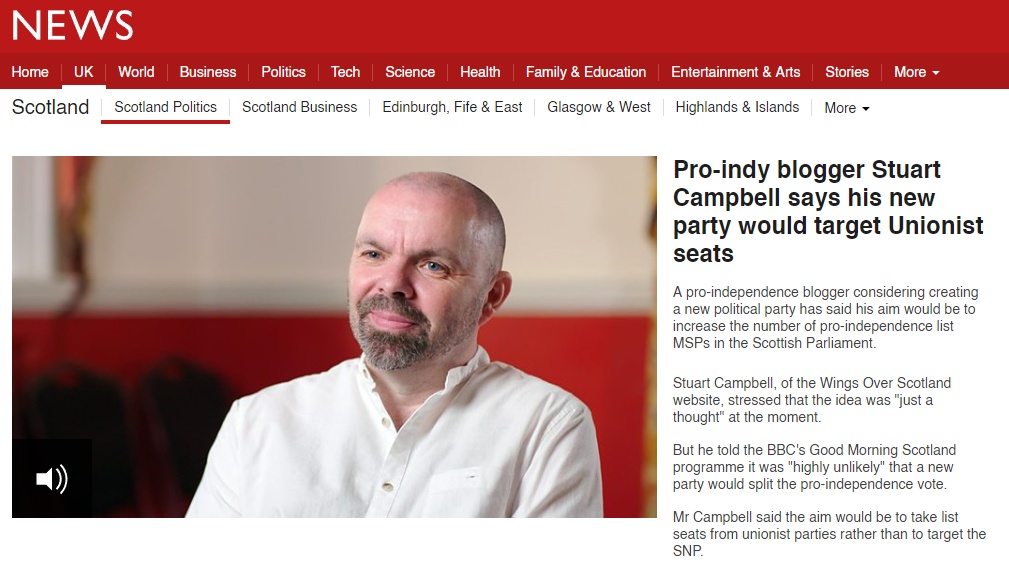
Crazy stuff happens when we have a thought.

Buckle in for a bumpy ride if you don’t like pictures of my ugly mug.


The general reaction of the Scottish media and political sphere was to fall over itself in a rush to find people to immediately rubbish the notion of a Wings list party, which rather suggested to us that it must be a good idea.
The plan to appeal to moderate, mainstream voters was unsurprisingly attacked bitterly by both the most extreme left-wing party at Holyrood and the most extreme right-wing party at Holyrood:
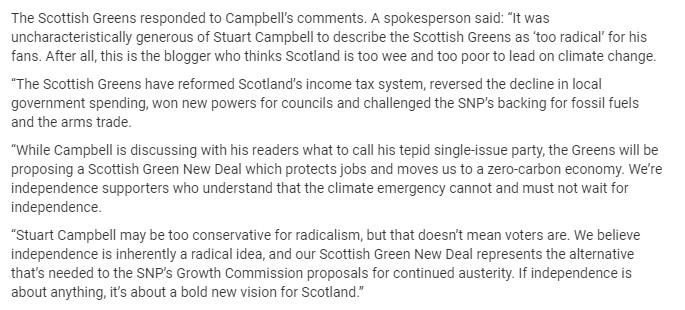

The shriekingly intolerant “woke” end of the Yes movement also went into a complete meltdown, including a demented editorial on a little-read blog which – ironically – had enthusiastically and aggressively advocated voting for fringe far-left parties on the list at the 2016 Holyrood election, insisting that “unity in diversity is a much stronger base for transformative action than one-dimensional party politics”.
(The concept of “diversity” in the Yes movement there presumably being used in its lesser-known sense of “exclusively views that agree with mine, with all others being intolerable outrages against basic human decency”.)
Alert readers may recall that RISE, the party being referred to in that article, gathered just 0.5% of the list vote in the subsequent election, less than a tenth of what it would have required to win even one seat. Its best result was getting 2,454 votes in Glasgow, one more than the “A Better Britain – Unionist Party” which has never been heard of before or since.
(The minimum vote required to win a seat in the region was 14,766.)
But anyway.
The events of the last few days have revealed an alarming lack of knowledge of how the Scottish Parliament’s electoral system works even among relatively politically-engaged members of the public, so it’d probably be useful to quickly lay out a few basics here.
1. Holyrood votes are NOT ranked by preference and are NOT transferable.
You have two votes – one for a constituency MSP to represent your immediate local area, usually a part of a town or city, eg Glasgow Provan. (We’ll call this the “local” vote to avoid having to type the word “constituency” over and over again)
You also have one vote to elect multiple regional MSPs for your general area, eg Mid Scotland And Fife. There are eight such electoral regions in Scotland, each returning seven MSPs.
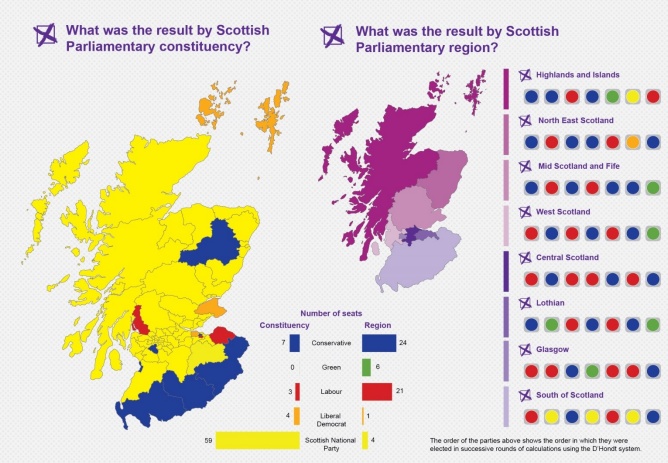
2. The simplest explanation of Holyrood’s electoral system is that it’s designed to ensure that each party’s total representation – local and regional MSPs combined – is equal to its proportional share of the REGIONAL vote alone.
(In practice this is rarely achieved precisely, but it gets pretty close. In 2016, for example, Scottish Labour got 19% of the regional vote and ended up with 19% of total seats. The Tories got 23% of the regional vote and 24% of total seats.)
On the most recent polls, the total pro-independence regional vote is sitting (as in fact it has been for the last two years) at around 45%, which if the system works as designed would mean Unionist parties having a majority of seats and any vote on a second independence referendum being defeated.

2. The hypothetical Wings party would NOT contest any local seats, only the regional vote. So you’d vote for your local candidate with your local vote (in our Glasgow Provan example the sitting MSP is the excellent Ivan McKee of the SNP), and for the Wings Party with your regional vote.
3. Why? Because in Glasgow, and also in most other Scottish regions, you’d be roughly 10 times more likely to get a regional Wings Party MSP than a regional SNP one from the same number of votes. That’s because the SNP currently hold all nine of the local seats in the Glasgow region.

What that means is that under the Holyrood electoral system the SNP’s regional vote gets divided by 10 (or to be precise, their number of seats in the region plus one) before the counting to elect regional MSPs begins.
So even though the SNP won the actual regional vote in 2016 by miles:

…the EFFECTIVE vote was actually this, with the SNP in fourth place:

Because their nine local seats meant the SNP’s regional vote got divided by 10. Which meant that the seven regional seats were allocated like this:
SEAT 1: Labour with 59,151 votes
SEAT 2: Labour with 29,575 votes (59,151/2)
SEAT 3: Tories with 29,533 votes
SEAT 4: Greens with 23,398 votes
SEAT 5: Labour with 19,717 votes (59,151/3)
SEAT 6: Labour with 14,788 votes (59,151/4)
SEAT 7: Tories with 14,766 votes (29,533/2)
The SNP’s adjusted vote of 11,110 was 3,656 short of the Seat 7 winning total, which means the SNP would have needed an EXTRA 36,569 votes (33% more than they actually got) just to get a single regional seat.
(Because they’d then have had 147,670 and dividing that by 10 would have given them 14,767 and let them pip the Tories to the final seat by one vote.)
So the final outcome of the 2016 election in the Glasgow region was this:
SNP: 9 seats (all local)
Labour: 4 seats (all regional)
Tories: 2 seats (all regional)
Greens: 1 seat (regional)
That’s a total of 10 pro-indy MSPs and six Unionists.
But if everyone who voted SNP on the regional vote had instead voted for the hypothetical Wings Party, the seats would have been allocated like this:
SEAT 1: Wings Party with 111,101 votes
SEAT 2: Labour with 59,151 votes
SEAT 3: Wings Party with 55,551 votes
SEAT 4: Wings Party with 37,034 votes
SEAT 5: Labour with 29,575 votes
SEAT 6: Tories with 29,533 votes
SEAT 7: Wings Party with 27,775 votes
That’s four pro-indy MSPs in the region instead of one. The SNP would still have their nine local MSPs, making an overall total of 13 pro-indy MSPs and just three Unionists, rather than 10 vs 6.
Annie Wells, James Kelly and Pauline McNeill would all have lost their seats (as would Patrick Harvie), replaced by Wings Party candidates.
Multiply that result across eight regions and you’d end up with 24 more pro-indy MSPs and 24 fewer Unionists, for a huge total pro-independence majority of 57 seats, with the new Holyrood comprising 93 pro-indy MSPs vs 36 Unionists.
(The reality wouldn’t be quite that simple due to the specific circumstances of different regions, but the general principle holds.)
And even if only one-third of SNP voters had voted Wings in the region (a more realistic prospect than all of them doing it), the boost to pro-indy numbers in the Holyrood chamber would still be almost as large – the seats would come out at 3 Lab, 2 Wings, 1 Con, 1 Green, or three pro-indy regional MSPs instead of one.
While the Holyrood electoral system isn’t complicated as such, it does take a bit of time to explain, as we’ve just seen. But the short version of all the above is that in every single region of Scotland, a Wings Party vote would effectively count for between five and 10 times as many votes as an SNP one in terms of electing pro-indy regional MSPs.
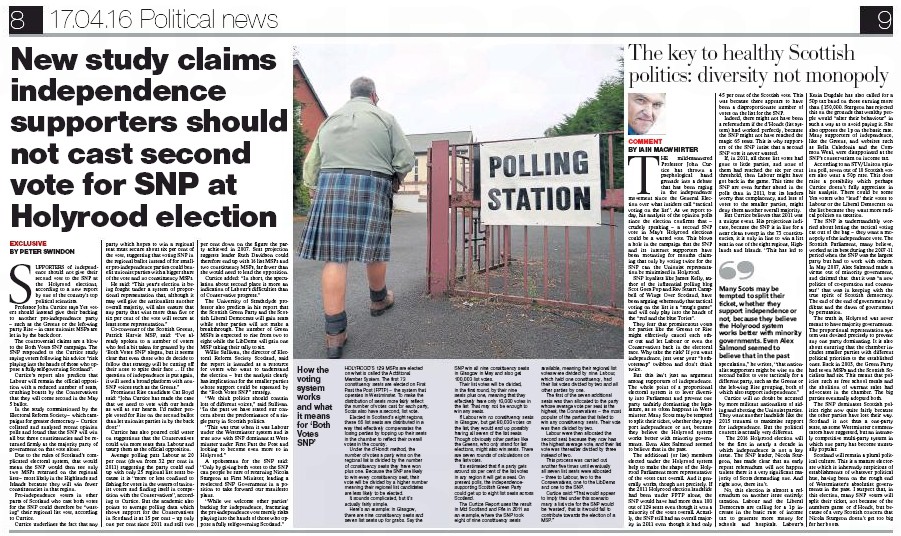
4. The key difficulty, of course – as this site has pointed out previously – is in persuading SNP voters to make the quite counter-intuitive step of voting for two different parties in the same election. (It’s occasionally suggested – with excessive cynicism in our view – that it was designed deliberately to that end.)
In our previous articles we noted, correctly, that SNP voters would be highly resistant to giving their regional vote to minor parties like the Greens or RISE or Solidarity, for a whole range of reasons. In the 2016 election, 90% of SNP local voters also voted SNP in the regional vote.
The crucial potential difference this time is we know from polling that SNP voters broadly tend to have pretty favourable feelings towards Wings Over Scotland. If – IF – that were to be translated into votes the tipping point required to actually start winning seats, which RISE etc were always going to fall far short of, would be pretty easily reached.
(For one seat in a region you’d need to get around 1 out of every 7 SNP votes.)
5. But if it didn’t work, could voting for a Wings party damage the pro-indy parties and lose a Yes majority at Holyrood? Well, in an abstract theoretical sense it could do, but in reality the arithmetic is very strongly against that outcome.
The only way it could be a real danger would be if the SNP vote lost a significant number of their local seats and therefore needed to pick more up on the regional lists. Given the shambolic state of Scottish Labour and the Scottish Tories that’s not hugely likely, but some of their majorities are small and nothing is impossible.
So in our Glasgow example, let’s imagine that the SNP lost five of their nine local seats – we’ll say three go to Labour and two to the Tories – and that a third of their regional vote had gone to the Wings Party. We won’t bore you with the full working here, but the outcomes would be these:
SNP KEEPS 100% OF REGIONAL VOTE: 5 SNP, 1 Green, 1 Labour
1/3 OF SNP VOTE TO WINGS: 3 Wings, 2 SNP, 1 Green, 1 Labour
Result: no change. Both outcomes deliver 6 pro-indy MSPs to one Unionist.
So that’s the theory. Our notional plan isn’t about “splitting” the pro-independence vote, it’s about multiplying it, by a factor of up to 10.
(How much it got multiplied would depend on how many pro-indy voters gave us their regional vote, and also on who won local seats. But current polling suggests that once again the vast bulk of those would go to the SNP, so the likely multiplication factor is at the higher end of the scale.)
Unionists don’t like the plan, for obvious reasons. The Scottish media don’t like the plan, for partly different but equally obvious ones. SNP hyper-loyalists don’t like the plan because they want the SNP to have total power rather than having to work with anyone else, which is a natural enough impulse for politicians (and would-be politicians) but on the current trajectory will lead to Holyrood’s pro-indy majority being lost in the name of narrow party interest.
And the “radical” woke fringe absolutely hate the plan because they despise Wings far, far more than they despise being in the UK.
To be honest, folks, we can live with that as a list of enemies. And we fervently hope the plan never has to be put into action, because that would mean it was 2021 and the SNP had completely blown both their 2016 mandate and the best chance of winning an independence referendum Scotland will ever have.
But as a Plan B, it looks pretty good to us.


