

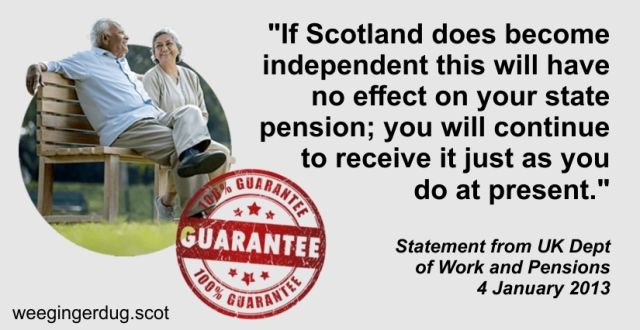
During the independence referendum of 2014, there were numerous reports of anti-independence activists who were canvassing on doorsteps, telling elderly people that if Scotland became independent, then they would lose their pensions. This was scaremongering of the very worst sort, an overt attempt to bully elderly people who very often subsist on one of the worst state pensions in Europe, threatening them with losing even the meagre pittance that the British state pension provides. The threat was absolutely, categorically, untrue. What made it all the more vile was that the British Government itself had already guaranteed that existing pensioners would continue to receive their state pensions.
The first point to be made here is that private pensions, local and central government pensions, and employee pensions will be unaffected by Scottish independence, at least from the point of view of the pensioner. The companies and agencies providing these pensions will continue to have an obligation to the pensioner no matter whether Scotland is independent or not. As a pensioner you have a right to one of these pensions because of an individual contractual agreement between you and the pension provider and because you have contributed to the pension fund throughout your working career. Following Scottish independence, there may be internal administrative issues for these pension providers to deal with, however this should not affect the amount of pension due to the pensioner nor their entitlement to that pension.
In the exact same way, you continue to be entitled to your private or employee pension should you decide to retire abroad to sunnier climes in the Caribbean. If the pension provider were to turn around and say, “Oh well, you no longer live in the UK, so we don’t have to pay,” you could sue them for breach of contract. And you’d win.
What we are really discussing here is the state pension. As already noted, the British Government has already guaranteed that existing pensioners and those who would become of pensionable age after a Yes vote but before Scotland becomes independent would be unaffected.
On 7 May 2014, the then UK pensions minister Steve Webb told the Scottish Affairs Committee in the House of Commons that older people would be entitled to continue receiving the current state pension even in an independent Scotland. He acknowledged that there would have to be a negotiation between Holyrood and Westminster about how these pensions would be administered, but assured the committee that Westminster would continue to have an obligation to pay the pensions to existing pensioners. When asked by a Labour MP if the pensions of existing pensioners would be secure following a Yes vote, Steve Webb confirmed that this was the case, saying “Yes, they have accumulated rights into the UK system, under the UK system’s rules.”
Then he added, “Take a Scottish person who works all their life and then retires to France… they still have an accumulated pension right in respect of the National Insurance they have paid in when they were part of the United Kingdom.”
Some opponents of independence claim that by voting for independence, people resident in Scotland will have voted to deprive themselves of any of the benefits of British citizenship, one of which is pension entitlement. This is nonsense. When the pensions minister was asked if a person’s citizenship made a difference, he replied, “Citizenship is irrelevant. It is what you have put into the UK National Insurance system prior to separation. Answer [for example] 35 years, that builds up to a continued UK pension under continuing UK rules. They are entitled to that money.” The minister’s remarks were reported by the BBC, here https://www.bbc.co.uk/news/uk-scotland-scotland-politics-27309215
As an aside, with respect to the citizenship issue, if you were born in what was UK territory to parents who were UK citizens, you will still have the right to UK citizenship following Scottish independence. As a resident of Scotland, you will also be entitled to Scottish citizenship, but assuming that the UK government doesn’t alter its citizenship laws (which it didn’t following Irish independence), then you’ll still have the right to UK citizenship should you choose.
What the pensions minister told the Scottish Affairs Committee was merely confirming what the Department of Work and Pensions had already informed an individual who had queried the matter of pensions in an independent Scotland. On 4th January 2013, the DWP wrote, “If Scotland does become independent this will have no effect on your state pension; you will continue to receive it just as you do at present.”
So if you are already in receipt of a UK state pension, you can be confident that you will continue to receive it after Scottish independence. Likewise if you are due to retire following a Yes vote but before Scotland becomes officially independent, your entitlement to a UK state pension is unaffected. It doesn’t matter what Gordie Broon tells you on the doorstep. Both the British and Scottish governments have a cast iron commitment to ensuring that existing pensioners will be unaffected by Scottish independence.
How those pensions are administered can’t be settled until after Scotland has voted for independence. Pensions will be a subject to be dealt with in negotiations between Holyrood and Westminster following a Yes vote. However the key thing to remember is that this is a matter for the pension provider, and that both parties will ensure that existing pensioners will be unaffected.
The real issue here is what happens to people in Scotland who are not yet of pensionable age, and who won’t become of pensionable age until after Scotland becomes independent. Although your entitlement to a state pension is based on the number of years you have been making National Insurance contributions, unlike employee pensions and private pensions where you pay into a pension pot during your working life, the state pension is “pay as you go”. The government allocates funds to pay the state pension from its current revenues, not from a pot of money that has been saved up from your National Insurance contributions and set aside specifically for the purpose of paying you a pension. Today’s state pensions are paid by today’s workers, and those workers in turn will have their state pensions paid by future workers.
Scotland is facing what has been described as a demographic time bomb. The population of Scotland in the early 21st century contains a higher percentage of older people and a smaller percentage of younger people than it did back in the 1950s. This means that the burden of providing state pensions will take up an increased amount of tax contributions from a numerically diminishing workforce. As a society, we’re all getting older. Which is a small consolation to those of us who have lost hair and teeth yet still fancy ourselves as trend setters. I remember having a drink fuelled conversation with friends back in the early 1980s when we joked that in the future old men would have earrings, old women would have coloured hair that wasn’t a blue rinse, and there would be OAPs with a complete collection of the best hits of The Stranglers. The future has arrived.
This isn’t just a problem for Scotland. All Western societies are facing a similar problem. Birth rates are declining as people have fewer children because women can now control their fertility in a way that wasn’t possible in the early 20th century. As medicine improves people are living longer. These are indeed better problems to have, but they do have the knock on effect of creating issues for future pension provision. The truth is that all countries are going to have to face up to these problems sooner or later. It will remain an issue for Scotland whether Scotland is independent or a part of the UK. However the demographic issue is particularly acute in Scotland because as a part of the UK Scotland is poor at retaining its young people, and because Scotland cannot do anything to promote the immigration of skilled workers.
Scotland can only take steps to tackle the demographic time bomb with independence. Then the Scottish Government will be able to introduce economic policies which develop the Scottish economy, leading to the country retaining a larger proportion of its young people instead of losing them to the economy of London. Scotland will also be able to introduce an immigration policy tailored to Scotland’s needs. Unlike the migrant-phobic Brexiteers, Scotland needs inward migration. Most of this can be expected to come from the rest of the UK and from other EU countries.
The UK also has difficulties due to the demographic time bomb. Scotland can’t escape this problem by remaining a part of the UK. The changing demographics of the UK is one of the most important reasons why the UK government is committed to equalising the age of retirement for men and women, and to raising that age of retirement. The way that the British government has carried out these changes have been deeply unfair to women who were approaching retirement age, many of whom feel that they are being deprived of their fair and just pension entitlement.
Finally, it needs to be said that although it’s difficult to make a direct comparison between different pension systems, the UK state pension is not notable for its generosity. The UK treats its elderly poorly and expects those without private or occupational pensions to subsist on a near poverty level of income. This problem is only going to get worse over time. In an independent Scotland we can aspire to do much better.
The plan for this article and several others dealing with key points in the independence debate is to collate them and publish them in book form when we have a date for the independence vote. Some of these articles have already been published on this blog and others have yet to be written. The idea is that when we know when Scotland will be voting, I will do a crowd-funder specifically for the purpose of raising money to get the book printed, and then it can be distributed to Yes groups and campaigners and given away for free.
There’s already a Wee Blue Book, let’s have a Wee Ginger Book too. This isn’t meant as competition for the Wee Blue Book – which is a fantastic initiative with proven success – but rather it is to be complementary to it. Different writing styles and different books can appeal to different readerships and different demographics. The more information we can get out there, the more people we can persuade to Yes. If you have any suggestions for topics for articles to include in this book, let me know and I will write something up – if I haven’t done so already.
Help this blog with a donation. There are a number of ways to donate. You can use the PayPal button on this page. you don’t need a Paypal account to use the donate button. If you don’t have a Paypal account, just select “donate with card” after clicking the button.
Alternatively you can make a PayPal payment directly to weegingerbook@yahoo.com, or you can click the following link to GoFundMe where credit and debit card donations are accepted.
https://www.gofundme.com/wee-ginger-crowdfunder-2019
If you would prefer to donate by cheque or some other method, please email me at weegingerbook@yahoo.com for details.
