

The constant refrain from opponents of independence is – How can Scotland become independent when you don’t even know what money you’re going to use? Eh? Eh? There is an underlying current of belief among such people that Scotland, uniquely among the nations of the world, would be incapable of having any sort of currency at all. And if Scotland does manage to find a currency, then it doesn’t matter what that currency is, it’s going to be a disaster.
Of course this unremitting negativity isn’t a reflection on Scotland’s currency options, it’s really a reflection of the mindset of diehard opponents of independence. If they are telling you that a resource rich, highly developed, economically advanced northern European country can’t have any currency at all that works for it, what they’re really saying is that they have an emotional objection to Scottish independence and they’re desperately trying to scare people away from the idea.
It is a fundamentally dishonest position to take, yet this was precisely the stance adopted by Alistair Darling (remember him?) the leader of the Better Together campaign in 2014. Despite repeated questioning during a debate, Alistair was unable or unwilling to answer a question about what form of currency was possible for an independent Scotland. If a person is setting themselves up as an expert on currency issues, it’s very revealing that they’re unable to say what form of currency is a good solution for a country like Scotland. Not so long ago there were South Sea islands with a neolithic culture which successfully used large stones with holes in them or exotic feathers as currency, but according to opponents of independence, Scotland is incapable of achieving something that can be managed by societies that hadn’t even invented the wheel.
The first thing that needs to be pointed out here is that there is no country in the world where independence has been predicated on the question of what currency it’s going to use. That was the very last thing on the minds of the Irish when they became independent from the UK in 1922. It didn’t trouble the Maltese when they became independent from the UK in 1964. It wasn’t a concern when Slovakia and the Czech Republic dissolved the former Czechoslovakia. All these nations quickly found a solution that worked for them. Scotland will do the same.
The only reason that the currency is an issue in the Scottish independence debate is because during the first independence referendum campaign, the then Scottish Government stated that its preference was to enter into a currency union with the rest of the UK following independence. In effect, what the independence campaign of 2014 was saying was, “We want to be independent Westminster, but we want you to cooperate with us on the currency question for the mutual benefit of both of us.” This was in effect asking for Westminster’s help for Scotland to become independent, and it has since been recognised as a major tactical error on the part of the independence movement.
Naturally opponents of independence said “No”, and they said no with considerable glee. Westminster politicians queued up to say that they’d refuse to sign up to a formal currency union with an independent Scotland, and they have continued to press the issue ever since because it allowed them to make the spurious argument that given Westminster’s refusal to agree to a currency union, independence supporters didn’t even know what currency they were going to use.
The important thing to take from this episode is that the arguments about currency are not primarily economic, they are political. We are no longer in 2014, and the Scottish Government and the independence movement are no longer asking for the cooperation of Westminster on the currency issue, or indeed anything else.
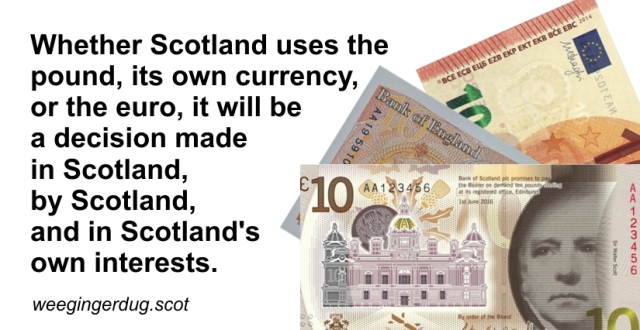
So back in the real world, there are essentially three options for a currency in an independent Scotland. These are continuing to use the pound, using a new Scottish currency, or adopting the euro. Any one of them would work for Scotland, the choice between them is really a political question. However the key thing to note here is that in an independent Scotland, it would be for a government elected by and answerable to the people of Scotland to choose, and that government would choose the one that works best for Scotland at the time.
According to current opinion polls, continuing to use the pound sterling remains the favoured option amongst people in Scotland. This is also the position of the Scottish Government, although the SNP has committed to moving to a new Scottish currency when the time is right. Despite what certain opponents of independence may tell you, there is absolutely no reason why Scotland cannot unilaterally continue to use sterling after independence, and to do so without a formal currency union with the rest of the UK. Scotland does not require the UK’s permission to continue to use the pound. Sterling is a freely tradeable currency. Westminster can’t stop Scotland from using it.
This is what Ireland did when it became independent. The Irish Free State of the 1920s continued to use the pound sterling for several years after Irish independence, until introducing an Irish currency, the punt, in 1928. When the punt was introduced and for many decades afterwards, it was kept at parity with sterling. Punts and pounds sterling continued to circulate freely throughout the entire island of Ireland. Like the UK at the time, Ireland continued to use pounds, shillings and pence. Irish coins were the same size and weight as their sterling equivalents. Ireland even switched to a decimal currency on the same day as the UK and the new decimalised Irish coinage remained the same dimensions and weight as the UK equivalent.
The advantage of continuing to use sterling unilaterally is that it makes for a smooth transition to independence. It would also help to protect the economy of the rest of the UK after it loses the revenue from Scottish oil and gas. Since the rest of the UK is a key trading partner of Scotland, it’s in our interests to ensure economic stability in the rest of the UK – all the more so since following Brexit the British economy is set to take a serious hit. This will help to protect jobs in Scotland. The disadvantage is that it leaves the Scottish economy too closely aligned to that of the rest of the UK and restricts the freedom of an independent Scottish government to make its own financial and economic decisions.
However it’s important to remember that an independent Scotland which continues to use sterling unilaterally is still an independent country. Montenegro uses the euro unilaterally, but no one can seriously claim that it’s not really an independent country as a result. Some opponents of independence claim that an independent Scotland unilaterally using sterling would have less independence than Scotland does as part of the UK. This is, frankly, just stupid. As part of the UK Scotland doesn’t currently have any say in determining the UK’s monetary policy or the interest rates of the Bank of England. Meanwhile it is subject to Westminster’s decisions on things like corporation tax, or austerity, or VAT rates.
The second option is to introduce a Scottish currency, which would probably continue to be called the pound. The new Scottish pound, like the punt, would most likely be kept at a 1:1 exchange rate with sterling, at least for several years. Other than seeing some new designs of coins, which would be the same size and weight as existing coinage, it’s unlikely that the average punter in Scotland would really notice much difference. After all, we already have distinctively Scottish banknotes. Moving to a Scottish currency on a par with sterling would merely formalise this arrangement.
The current Scottish Government has proposed that it will continue to use sterling unilaterally, and will only move to a Scottish currency when six tests are met. Essentially these tests boil down to proving that there is an appetite amongst the public for a new currency, ensuring that there’s a stable central bank and currency reserves to back it, and making certain that the new currency will suit the needs of the Scottish economy better than sterling. Others within the independence movement seek a quicker move to a new currency. However the key take-away here is that the introduction of a new currency will only take place when the people of Scotland desire it, and when it’s in the interests of the Scottish economy to do so.
There are steps to take to set up a new currency, and these steps can be complex, but the other important point is that introducing a new currency is not, as opponents of independence would have you believe, on a par with finding a solution to the problem of faster than light travel. Introducing a new currency is not some huge leap into the unknown, it does not require radically new and hitherto unknown breakthroughs in science or technology or economics. This is currency, not science fiction. It’s not beyond the capabilities of a modern European nation with a developed economy like Scotland.
Setting up a new currency has been done before many times, and even in countries which have far smaller and weaker economies than Scotland the process has gone quickly and smoothly. After the dissolution of Czechoslovakia, the new Slovakia took just one month to set up its new currency, the Slovak koruna. After the dissolution of the Soviet Union, Estonia took only ten months to set up the kroon. The advantage of a new currency is that it permits the Scottish government of the day freedom of movement on monetary policy and interest rates. Yet it does need to be noted that at present a majority of people in Scotland would prefer to continue with sterling. This may well change after independence.
The third option is to use the euro. There are probably more myths, misconceptions, and outright lies about this option than about any of the others. It’s very much in the interests of opponents of independence to sow confusion on this topic, as at the moment there is no majority in Scotland for adopting the euro, not even among most people who are already convinced supporters of Scottish independence.
The first to note is that following Scottish independence, Scotland cannot be forced to use the euro. Neither can Scotland transition immediately from using sterling to using the euro. Before Scotland can adopt the euro, it must first have established its own currency and all the requirements that go along with that. That new currency must have been in use for a period of at least several years to ensure that it is properly bedded in, and then once that has been achieved Scotland must sign up to the European Exchange Rate Mechanism II (ERM II), for a period of at least two years. Then, and only then, could Scotland adopt the euro. So even if Scotland had a clear desire to adopt the euro, which isn’t currently the case, it would not be able to introduce the euro as its currency for several years after independence, and probably more than a decade.
Although joining the EU does mean that a new member must “sign up” to the euro, there is no set timetable for doing so, and there are no penalties for not doing so. It would be entirely for the Scottish people and government of the day to decide when or if Scotland was going to adopt its own currency, and then it would be up to the government of the day to decide when or if Scotland was going to join the ERM II. These are entirely voluntary steps, and the EU does not set a schedule for a member state to do so and neither does it impose sanctions of any sort on a member which doesn’t comply.
Sweden and the Czech Republic have both effectively stalled on the euro indefinitely, even though they are theoretically obliged to adopt it. The UK is very proud of its opt out, but in reality a formal opt out is not required, there is an effective opt out in the fact that the decision about when to join the ERM II is entirely up to the member state and there are no punishments or negative consequences from the EU for not doing so. Neither Sweden nor the Czech Republic have joined the ERM II, and neither have set any date for doing so.
Joining the euro may be a good option for Scotland at some point in the future, but it’s not going to happen any time soon. And when it does happen it will only be because a government with a mandate from the people of Scotland to do so is convinced that it’s in the best interests of Scotland. Scotland within the UK is so used to being powerless and a victim of UK economic decisions which do not benefit this country that opponents of independence are determined to persuade people that following independence Scotland will still be powerless. That is categorically untrue. If Scotland ever does adopt the euro as its currency, it will only happen with the consent of the people of Scotland.
The most likely scenario is that upon independence, Scotland will continue to use sterling unilaterally for at least several years. When a new Scottish currency is finally adopted, it only be when there is a public appetite for it, and that new currency will most likely be kept at a 1:1 exchange rate with sterling. The new Scottish pound and sterling will continue to circulate freely in Scotland. Ordinary people are unlikely to notice much of a difference.
The important thing however, is that in an independent Scotland, the country’s financial and economic decisions will be made by a Scottish government which is answerable to the people of Scotland, and which makes those decisions in the interests of Scotland. What will not happen is what we have as present, a British government which makes financial and economic decisions in the interests of London and the South East of England. After independence, whatever currency we’re using Scotland will control its own money and make economic decisions in its own interests. That’s what controlling your finances is really about, not which currency it’s denominated in.
The plan for this article and several others dealing with key points in the independence debate is to collate them and publish them in book form when we have a date for the independence vote. Some of these articles have already been published on this blog and others have yet to be written. The idea is that when we know when Scotland will be voting, I will do a crowd-funder specifically for the purpose of raising money to get the book printed, and then it can be distributed to Yes groups and campaigners and given away for free.
There’s already a Wee Blue Book, let’s have a Wee Ginger Book too. This isn’t meant as competition for the Wee Blue Book – which is a fantastic initiative with proven success – but rather it is to be complementary to it. Different writing styles and different books can appeal to different readerships and different demographics. The more information we can get out there, the more people we can persuade to Yes. If you have any suggestions for topics for articles to include in this book, let me know and I will write something up – if I haven’t done so already.
Help this blog with a donation. There are a number of ways to donate. You can use the PayPal button on this page. you don’t need a Paypal account to use the donate button. If you don’t have a Paypal account, just select “donate with card” after clicking the button.
Alternatively you can make a PayPal payment directly to weegingerbook@yahoo.com, or you can click the following link to GoFundMe where credit and debit card donations are accepted.
https://www.gofundme.com/wee-ginger-crowdfunder-2019
If you would prefer to donate by cheque or some other method, please email me at weegingerbook@yahoo.com for details.
