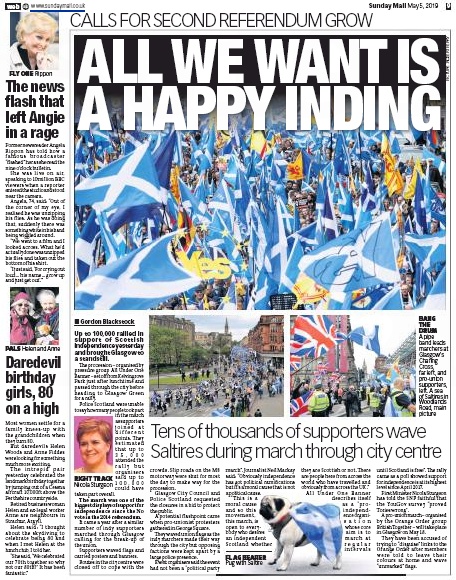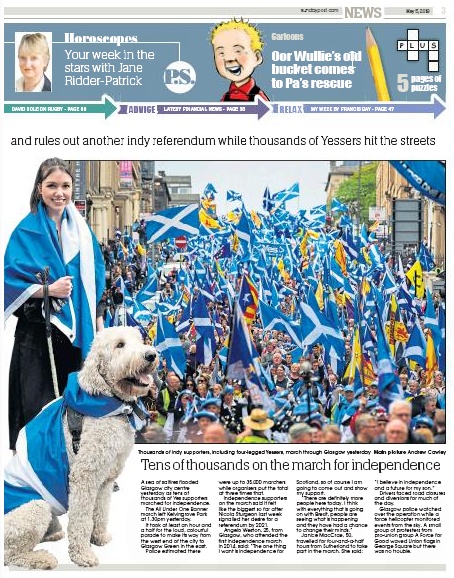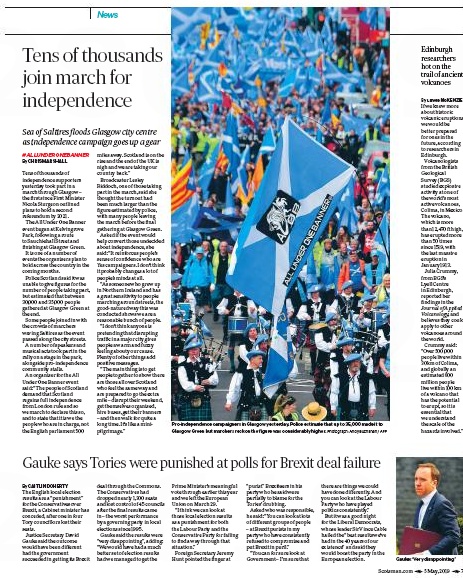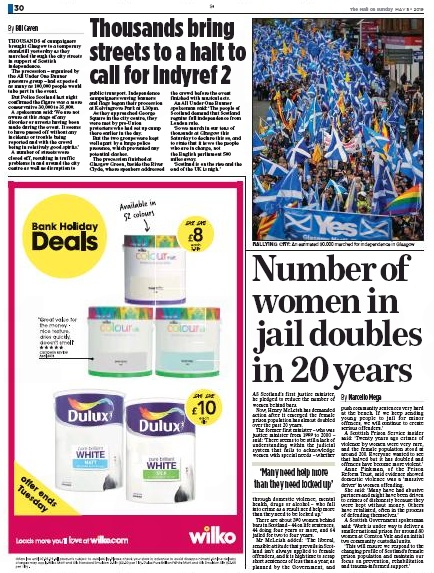


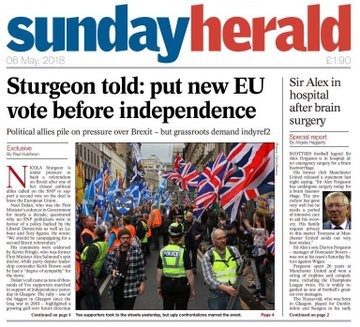
On Saturday, for the second year in a row, there was a huge and joyous independence march through the centre of Glasgow, which passed off with no incidents, arrests or disturbances despite attempted provocation from a small handful of abusive Unionist bigots led by a Holocaust denier.
Most of the Sunday papers carried largely neutral and factual reports of the event, of varying quality and size, with only a comical piece of hysteria in the extremist Scottish Daily Express standing out as objectionable for its ridiculous headline (and even then the actual copy barely mentioned the march at all).
But also for the second year in a row, one paper – or to be more specific, one man – took a rather more negative slant.


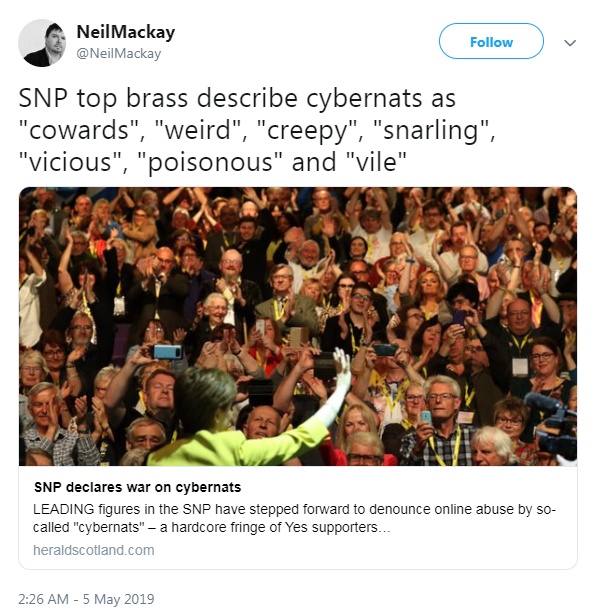
The Herald On Sunday ran with a four-page cover splash by former Sunday Herald editor Neil Mackay about vile “cybernats” having war declared on them by the SNP.
It followed a similar extended rant by Mackay following the previous year’s Glasgow march, at which the ostensibly pro-independence Sunday paper had infuriated readers by portraying the march as a violent clash between rival mobs and using it to attack the SNP, then using the reaction as an excuse for a three-page hyperbolic outrage piece on – you guessed it – vile “cybernats”.

The Yes movement gets very little positive coverage in the media, so many people remarked that it was curious for a professed independence supporter to spurn two such rare opportunities to show the movement at its best, and to instead undermine it by sowing internal anger and division, and gleefully hand opponents a weapon with which to beat it (which they of course seized eagerly).
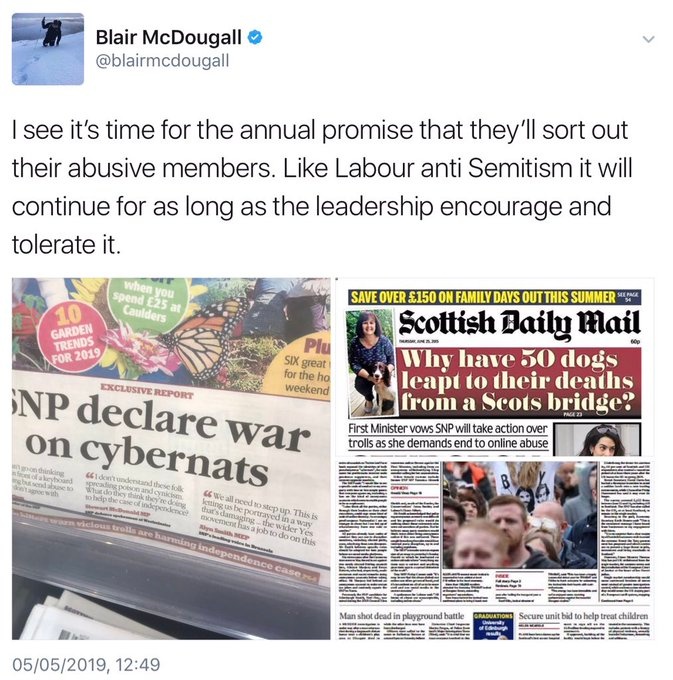

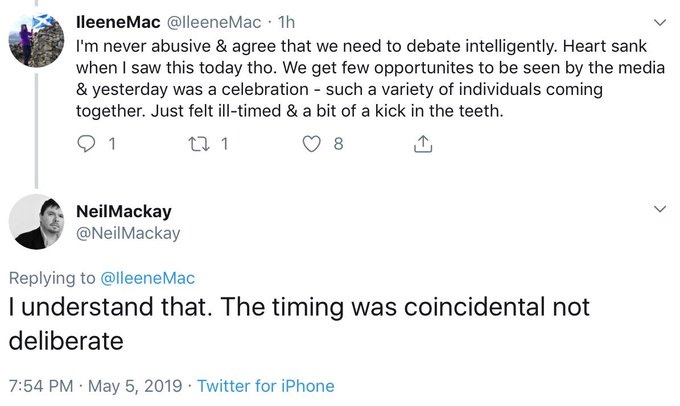
Rather remarkably, Mackay – who had carefully laid the groundwork for the piece with a column in the Herald earlier that week, and who has a long track record of causing bitter ructions in the Yes movement at key moments – attempted to pass the timing off as a coincidence.
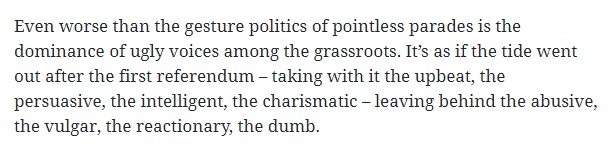
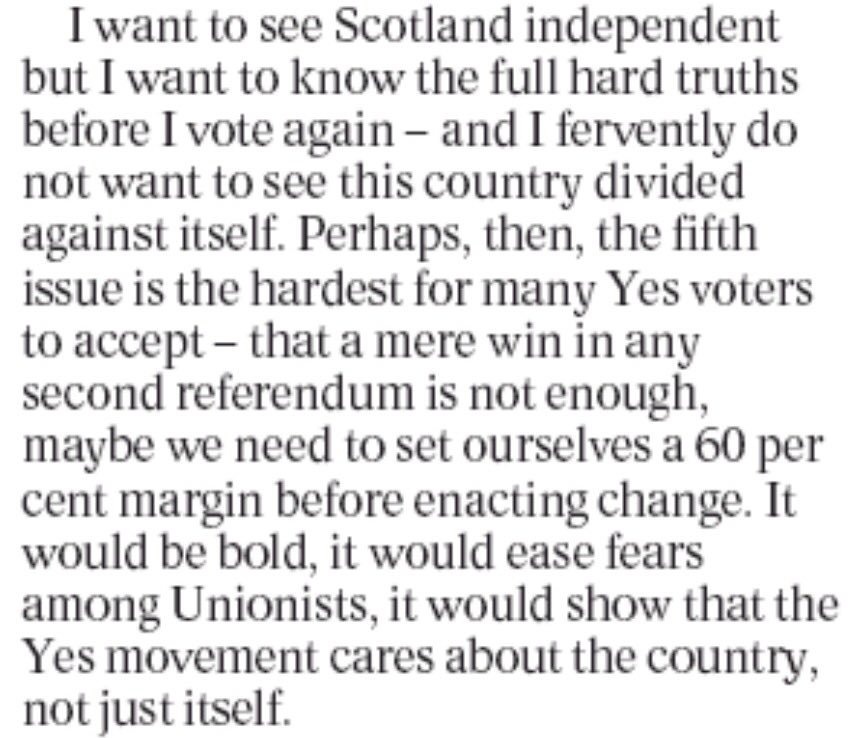
(In the column Mackay had attacked marches as “the gesture politics of pointless parades”, claimed the movement now only comprised “the abusive, the vulgar, the reactionary [and] the dumb”, and proposed the notion that any second referendum on independence should impose a threshold of 60% for victory, meaning that if Yes won the vote by 59% to 41% independence would still be rejected. That’s, let’s say, an interesting position for an independence supporter to take.)
A significant part of Sunday’s article comprised thinly-veiled attacks by Mackay on this site, despite none of the named SNP “top brass” having mentioned it.
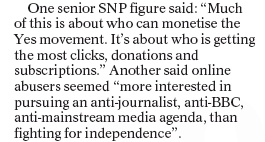
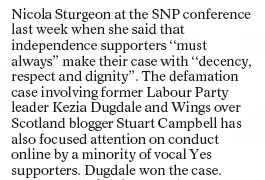
(We’re a bit confused as to how he arrived at the conclusion that the defamation case “focused attention on conduct online by a minority of vocal Yes supporters”. None of those were mentioned in court. The case focused on Kezia Dugdale being found to have made untrue and defamatory smears.)
But this site has done more than most to try to damp down the extremities of online abuse. We maintain a frequently-updated and customisable Twitter blocklist to which anyone can subscribe, containing thousands of abusive accounts – Yes and No alike – which seek to troll and provoke, and have repeatedly urged readers not to become drawn into extended shouting matches with them.

(It would be silly to deny that we use some fruity language ourselves from time to time on social media, of course, but it’s usually a single “F— off” immediately before adding someone to said blocklist. Ironically the blocklist itself – a positive and practical attempt to reduce the amount of antagonism on Twitter – is regularly used as a reason to aim more abuse in our direction.)
But what particularly upset many Yes supporters this weekend was the participation of several SNP politicians in Mackay’s obsessive and “coincidentally”-timed attacks. And a part of the article contained a telling rationalisation from one of them.
“It isn’t just so-called ‘cybernats’ that worry Alyn Smith. He’s concerned about possible ‘false flag’ accounts on social media posing as Yes supporters. ‘There are vast amounts of Yes-identifying accounts that are signalling against the SNP and causing arguments among the Yes side,’ he says.
‘On Twitter there are clearly and demonstrably phoney accounts. I’ve got to the point where unless I see a name and a face, I don’t think that half of this is genuine … It is beyond doubt that there are phoney Yes accounts that are actually not on the Yes side, and indeed there are phoney unionist accounts as well that are there to be abusive.’
Smith points out that in the abortion debate in America, Russian troll farms ramped up both sides of the argument. ‘This can be easily done,’ he says.
Smith is also concerned about hostile foreign interference in domestic politics. He recalls making a speech where ‘if I didn’t mention Russia, I certainly mentioned dark forces trying to influence the election’. He adds that he quickly received messages saying things like ‘I hope you die’ which he believes were ‘clearly coming out of the same troll farm in Vladivostok’.”
Let’s assume Smith is right about that, because he almost certainly is. It’s entirely likely that both hostile governments (whether at home or abroad) and false-flag Unionists are involved in ongoing efforts to covertly influence the debate for their own reasons. The UK government quite openly maintains a military-intelligence unit dedicated to precisely such pursuits, so it seems unlikely that other countries don’t.

Indeed, as a pro-indy lawyer friend of ours is fond of saying, “Speaking as a British taxpayer, if the UK security services AREN’T actively infiltrating and subverting the Yes movement I want my money back”.
But what Smith fails to do is follow that thinking to its logical conclusion. If we assume that some abusive Yes accounts are indeed Russian troll operations or Unionist false flags set up to discredit the independence movement, what would they be hoping to achieve? What would they regard as a good day at the office?
One might fairly imagine that the answer “a succession of large articles in broadsheet newspapers about how dreadful ‘cybernats’ are, ideally all penned by a supposed independence supporter, backed by others echoing Unionist tropes about ‘fascism’ and endorsed by senior SNP figures” would be quite near the top of their list of goals.
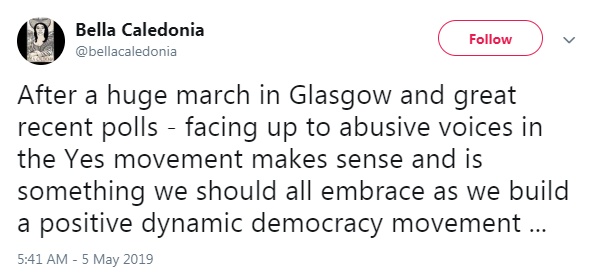

Most troll accounts are anonymous, have tiny numbers of followers and their tweets are seen or heeded by almost nobody. (Quite aside from the fact that Twitter itself is already a tiny minority interest anyway.) The only way to turn them into a meaningful weapon against the Yes movement is to massively amplify them via the media.
If we were running an MI5 smear factory and managed to get a four-page cover story about terrible cybernats – written by an ostensibly pro-Yes journalist and seemingly officially backed by the SNP – into a newspaper, creating negative headlines in the Unionist press AND massive discord within the independence movement on a day when it was otherwise generating hugely positive imagery and coverage, we’d take the rest of the week off and throw a massive party.
And if we’d managed to get the same guy to pull the exact same trick two years running, we’d be demanding a hefty bonus as well.
Especially if both the author and his newspapers had been heavily engaged for years in attempting to deflect suspicion by calling everyone else an MI5 plant.

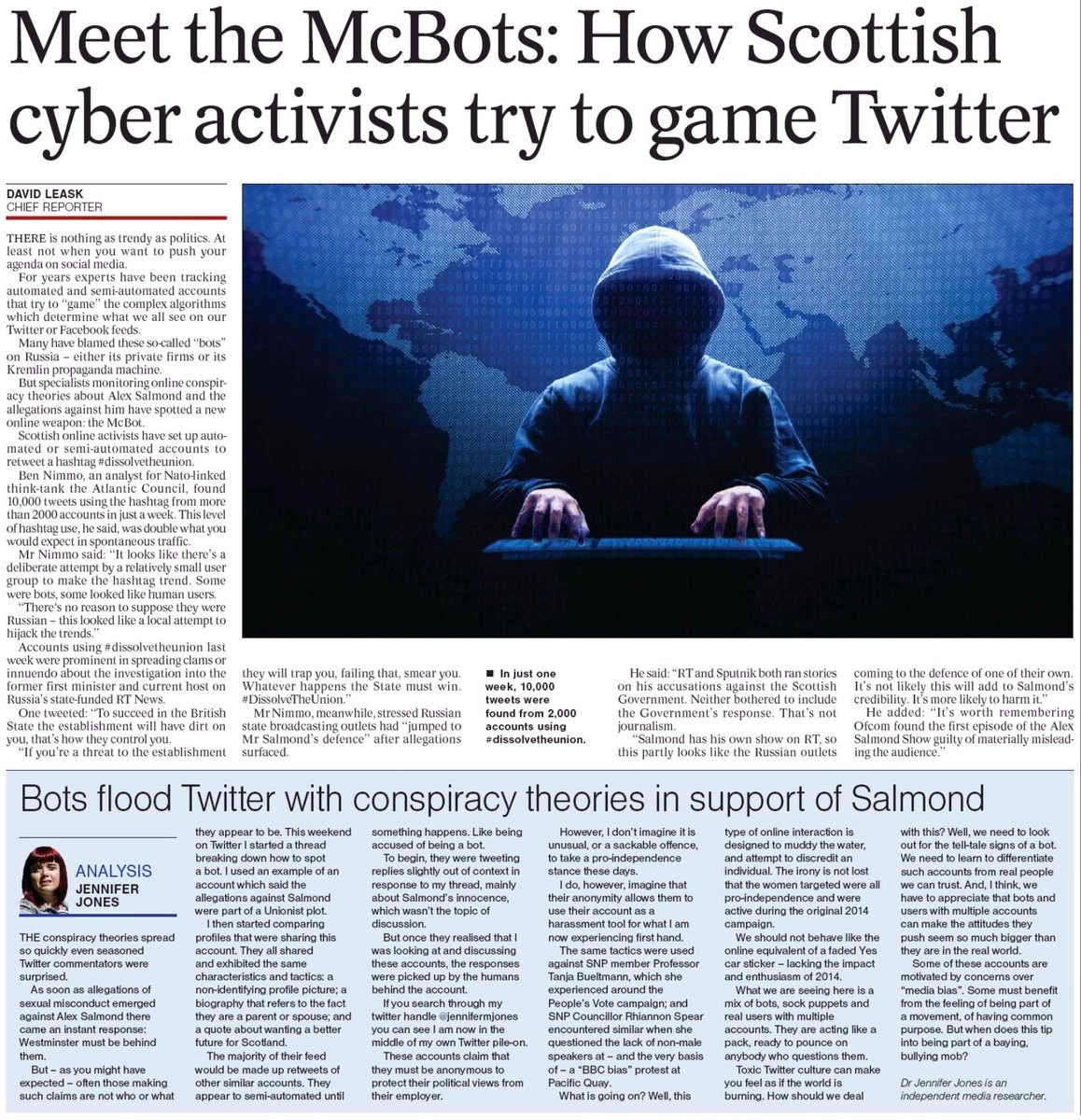
(In years when there HASN’T been a march, incidentally, Mackay has still diligently tried to smear the movement as being infested with a “creepy fruitcake crackpot cult”. He’s as regular as a train-station clock made of All-Bran.)
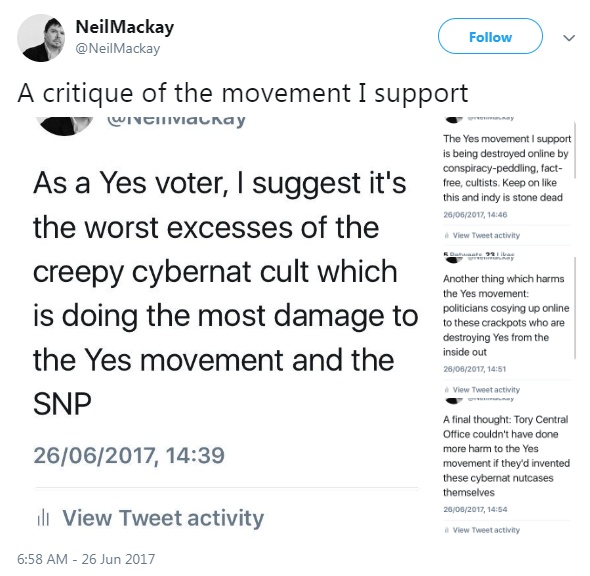
Now, we don’t think Alyn Smith, Angus Robertson and Stewart McDonald – who were all phoned up individually by Neil Mackay rather than them collectively approaching him – are in the pay of either Vladimir Putin or MI5. (Well, okay, if we’re absolutely honest we’re pretty sure about two of them.)
But they might want to take a moment to think about what those entities would want from them if they were, and whether in that case it might be a good idea not to keep giving it to them for free.