



Campaigners have called for Scotland’s lawmakers to reject a sex work policy after recent statistics showed that violent crime against sex workers almost doubled after it was introduced in Ireland.
Sex workers in Ireland have reported a 92 percent increase in violent crime since the “Nordic Model” came into place in March 2017. This is a Swedish law which criminalises people who buy sex rather than those who sell it.
The sharp increase was revealed after statistics were released in March by UglyMugs, an app where sex workers can report incidents of abuse and crime, and receive alerts about dangerous clients.

Charities in favour of decriminalising sex work said the stats were “sadly not surprising” and added to evidence that the law hinders the ability of people “to report violent crimes, exploitation and abuse.” One called for a “Scottish Model” of regulation.
Groups in favour of criminalising sex workers’ clients argued that doing so reduces demand and holds to account “those who profit from the sexual exploitation of others” and from “human misery, such as pimps and human traffickers.”
Some sex workers described the Nordic Model as an “ill-thought-out policy” that puts them at risk from “criminals and violent clients” by pushing the practice further underground.
They called on the Scottish Government to consult them regarding future policy making.
The Scottish Government said they were focussed on preventing “vulnerable individuals” entering sex work, reducing the prospect of harm and trafficking, and supporting those looking to exit the industry.
Sex work in Scotland is currently legal but aspects such as “soliciting” or “loitering” on the streets, as well as “brothel keeping”, are illegal. Sex workers working in pairs from a flat for protection are also said to have been prosecuted for brothel keeping, something the Scottish Government has acknowledged.
There is fierce debate between politicians, campaign groups and charities about whether to criminalise further elements of sex work, or move towards decriminalisation.
But reports from some countries where the Nordic Model was adopted said that the law has increased violence against sex workers, among other issues such as the contraction of HIV.
A 2018 study by aid agency Medecins du Monde found that the law had a “detrimental effect on sex workers’ safety, health and overall living conditions”. Some participants in the survey said the law had triggered a “decrease in condom use as well as increased difficulties continuing treatment for those who are HIV positive”.
Calls for a ‘Scottish Model’ of regulation
Nadine Stott, chair of sex worker charity SCOT-PEP, said it was “sadly not surprising that the Nordic model makes sex workers less safe.” “This is something sex workers themselves have known since the law’s inception,” she added.
Stott explained that a client is able to “use their worry about criminalisation” to dictate the place of meeting. Men can also pressure sex workers to get into their car before discussing “services, prices and condom-use”.
“The implications for the sex worker’s safety are obvious”, Stott said.
She continued: “The other huge problem with the Nordic model is that it doesn’t decriminalise sex workers. In Ireland, it actually increased the penalties sex workers face for working together, while in France, local authorities retain the ability to fine street-based workers.”
Any form of criminalisation of sex work has the effect of reducing sex workers’ ability to report violent crimes, exploitation and abuse.
Dr Anastacia Elle Ryan, Umbrella Lane
Dr Anastacia Elle Ryan, director of a sex worker support charity in Glasgow called Umbrella Lane, said the Irish statistics showed that “any form of criminalisation of sex work has the effect of reducing sex workers’ ability to report violent crimes, exploitation and abuse.”
She claimed that making some elements of the industry illegal in Scotland had deterred sex workers from approaching “agencies that work in partnership with police.”
Ryan called for “a ‘Scottish Model’ of regulating sex work that would decriminalise the industry” and strengthen “laws against actual and not perceived coercion and exploitation”.
She said that an approach “designed with sex workers and sex worker-led organisations at the policy-making table” would show that the Scottish Government is serious about ensuring that women’s rights are protected by law.
Challenging demand ‘firmly rooted in a human rights and equalities’
A Swedish Government report reviewing the impact of the Nordic Model found that by 2008, street prostitution in Sweden had been reduced by half compared to when the law was introduced in 1999. It added that in the same period, “the number of women in street prostitution in both Norway and Denmark subsequently increased dramatically”.
The report also referenced a survey which showed a drop in demand amongst male clients, and said sex workers had not reverted to internet-facilitated sex work, despite a rise in the practice. The National Criminal Police believed the ban had acted as a barrier to human trafficking in Sweden, the report said.
It claimed fears that criminalisation would drive “prostitution underground”, increase physical abuse and worsen conditions for sex workers had “not been realised.”
Prostitution is not compatible with gender equality, and it therefore follows that we do not support calls to decriminalise those who profit from the exploitation of others, such as brothel owners.
The Women’s Support Project
The Women’s Support Project are a group leading End Prostitution Now, a campaign to make the purchase of sex illegal in Scotland. A spokeswoman for the group said it supports approaches that do not criminalise sex workers, and which “hold to account those who profit from the sexual exploitation of others” while reducing demand.
She added: “We share the Scottish Government’s view that prostitution is not compatible with gender equality, and it therefore follows that we do not support calls to decriminalise those who profit from the exploitation of others, such as brothel owners.”
Glasgow’s Violence Against Women Partnership, another group involved in End Prostitution Now, said it supported the decriminalisation of sex work, but said: “Those who create the demand by paying for sex should be targeted by the law, along with those who profit from human misery, such as pimps and human traffickers.”
Sex workers: policy makers have ‘fingers in their ears’
Glasgow-based sex worker Megara Furie said that her experiences of the Nordic Model in Ireland and Northern Ireland had left her “fearful for the first time in a career spanning almost nine years.”
The law made it harder to vet clients who had taken to more clandestine operations, such as using “burner phones” and fake identities, said Furie. “The power imbalance this creates is terrifying.”
Furie warned that “criminals and violent clients will be seeing this situation as easy pickings for committing crime as it is more likely workers will take bookings because lack of screening will become the norm”.
“The Nordic Model is the most ill-thought-out policy by people who have never set foot in the industry themselves and soon will be the biggest contributor to violence against workers. The very thing this insane policy is supposed to stop.”
Lydia Caradonna, a sex worker and member of the UK-based Sex Worker Advocacy and Resistance Movement, echoed Furie’s comments. She claimed that the Norwegian Government had acknowledged that the law had created a “Buyer’s Market”.
Cardonna added that the law fails to reduce demand in the sex industry because it “completely fails to address the reason that most of us are here in the first place: financial need”.
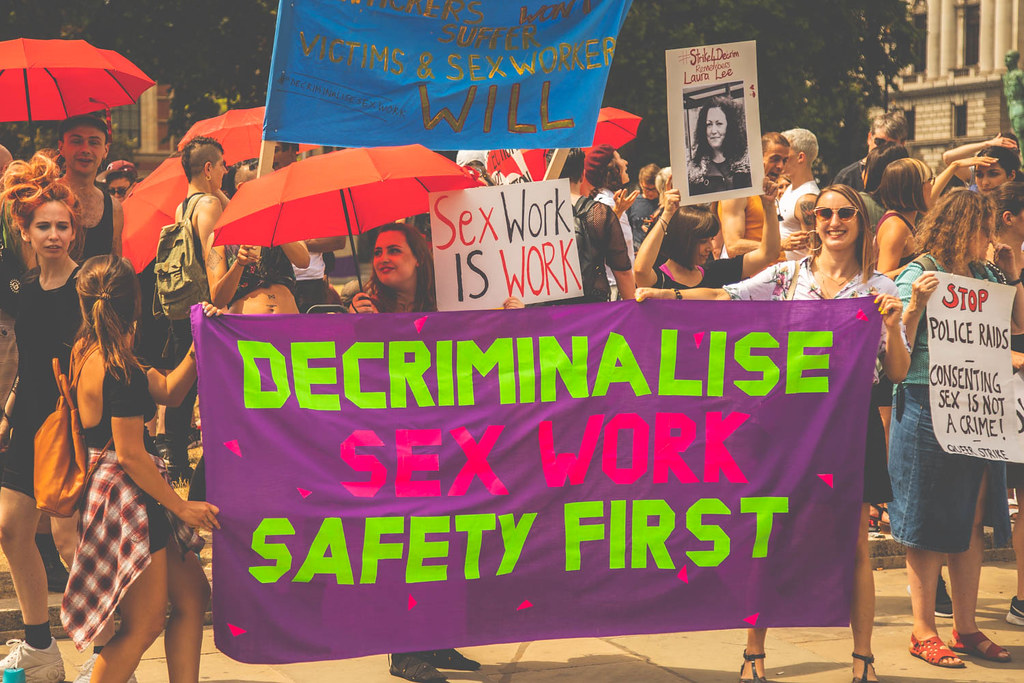
“We need more rights and more opportunities, and most importantly we need safety. We advocate for a decriminalised sex industry,” she said.
Enlarge
Sex work, HIV and human rights
The decriminalisation of voluntary sex work is supported by numerous international organisations including Human Rights Watch and Amnesty International, who both believe it will help to protect the human rights of sex workers.
The United Nations and its World Health Organization agency also advocate decriminalisation, which, according to a 2014 UN report, “is key to changing the course of the HIV epidemics among sex workers and in countries as a whole”.
Decriminalisation is also supported by HIV Scotland. The charity’s chief executive, Nathan Sparling, warned of the “increased vulnerability to HIV and other sexually transmitted infections”.
He said that “criminalising sex work and HIV non-disclosure, exposure and transmission create barriers for sex workers living with HIV to realising their human rights and accessing justice.
“The Nordic Model is one that retains an aspect of criminalisation, and with growing evidence that it increases risk to the safety of sex workers and to their long-term health, it is one that HIV Scotland cannot support.”
Exposed – human trafficking for the sex industry in Burkina Faso
Scotland’s political parties and sex work policy
As well as campaign groups, Scotland’s political parties are divided on which approach to take towards sex work. While the Greens and Lib Dems support full decriminalisation, Labour and the SNP support approaches akin to the Nordic Model.
A resolution to mirror the Scandinavian law in Scotland was passed at the SNP’s 2017 spring conference. It was originally proposed by the Ash Denham MSP, the Scottish Government minister for community safety, who argued the law would help to tackle gender-based violence and human trafficking.
A Scottish Government spokesperson said they were “focussed on preventing vulnerable individuals entering prostitution, reducing the harm associated with the selling of sexual services, and supporting those who wish to leave.
“The law is clear that no one can be forced into sexual activity without their consent, and we encourage the prosecution of those who seek to exploit others.
“We are working in partnership with criminal justice agencies and support organisations to make Scotland as hostile an environment for trafficking and exploitation as it can be, and to ensure victims receive the support they need.”
We are working in partnership with criminal justice agencies and support organisations to make Scotland as hostile an environment for trafficking and exploitation as it can be, and to ensure victims receive the support they need.
Scottish Government
In 2012, Labour MSP Rhoda Grant lodged a bill to criminalise the purchase of sex, which did not pass. She said the law had “led to the reduction of street prostitution and human trafficking in Sweden and that has to be celebrated.”
Grant added: “Essentially it is a three pronged approach; decriminalising those in prostitution, criminalising buyers and those exploiting people in prostitution and essentially providing support to exit.
“The Nordic model also makes it easier for women to report violence because they have been decriminalised and the buyer has already committed a crime by buying sex, making it easier to prosecute.”
The Scottish Greens’ justice spokesperson John Finnie MSP said that the law “should not put the safety, health, and wellbeing of sex workers at greater risk”. He said the recent Irish stats “reinforce longstanding concerns that the Nordic model doesn’t offer sex workers the protections they need.”
Reinforcing their support for decriminalisation, the Scottish Lib Dems overwhelmingly rejected the Nordic Model at the party’s conference in February.
“The current law is failing in its duty to protect sex workers”, a party spokeswoman told The Ferret. “Numerous international agencies and charities hold up a model of full decriminalisation of sex work as best practice.”
This story was co-published with the Sunday National on 21 April.
Photo thanks to Juno Mac/SWARM, CC BY-NC-ND 2.0

