



A few weeks ago when we said Wings was going to take a break for a bit, we also said “There may be posts now and then if something particularly significant happens”. Well, this week something particularly significant happened.

It was a development that we’d been predicting ever since Boris Johnson became UK Prime Minister, but it’s no less important for that. And it’s not an exaggeration to say that it could be the deciding factor in whether Scotland becomes independent.
Until now, advocates of “gender recognition reform” could dismiss it as an irrelevance in terms of the independence issue on the grounds that the Tories were planning to introduce it in the rest of the UK anyway. But that’s no longer the case.
Should there be an independence referendum any time soon – and we remain firmly of the belief that there’s no chance of that while Nicola Sturgeon leads the SNP, a belief she reaffirmed today on the Andrew Marr Show – there will now be a distinct choice facing all Scottish women: the choice between independence and protecting their sex-based rights to at least some degree by staying in the UK.
For many women (particularly after an abysmally glib, dishonest, condescending and evasive defence of the proposals by Shirley-Anne Somerville on Scotland Tonight on Thursday), that’s going to be no decision at all.


We could post another 100 examples, But to assess how significant the effect might potentially be, it’s worth restating just HOW unpopular gender reform is among women (and all other voters), even when the question is framed by those in favour of it.

(Interestingly, the Pink News story that Herald piece refers to has now been vanished from the Pink News website. The poll data can still be found on YouGov, showing that less than one in five women back letting people self-declare their legal sex.)

Poll after poll after poll, using every imaginable variant on the question, has found broadly identical results, with very little difference between demographics – male or female, Yes or No, SNP, Labour or Tory, wealthy or poor, Remain or Leave.
In March 2019, only 17% of Scottish voters supported self-declaration of sex.
The same poll, only 14% thought transwomen should be allowed to compete in sport against biological women.
In October 2019, only 25% of Scots thought people should be able to change the sex on their birth certificate at all, never mind doing it purely on their own say-so without a medical diagnosis.
In May 2018, only 19% of English voters thought self-ID was a good idea.
In December 2017, only 18% of Scottish voters thought self-ID was a good idea.
Let’s put those numbers on a chart just to visualise it.
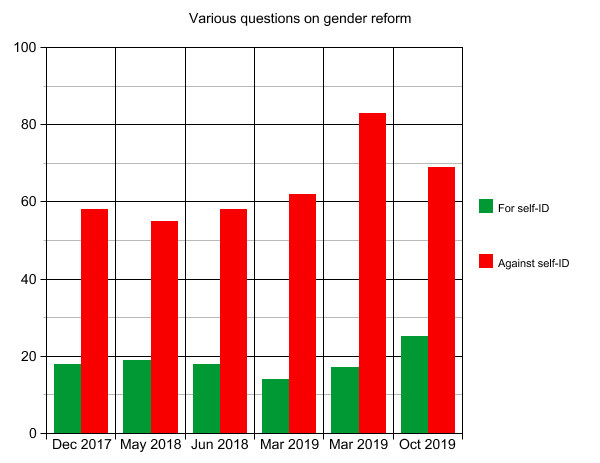
But what if we focus only on the sort of people likely to vote for independence in the first place? Late last year we polled SNP voters specifically on the subject, and the number who described themselves as “totally opposed” to the gender reforms – 0 on a scale of 0 to 10 – was 18%.
(Or 33% if you include anyone ranking their support between 0 and 3/10.)
If we use the 2019 UK general election as a basis for the number of SNP voters, 18% is 223,628 people. The number of switched votes required to reverse the result of the 2014 independence referendum would have been 191,969.
We saw earlier in this article that some people are indeed so opposed to self-ID that they would vote against independence to prevent it. If only those SNP voters who describe themselves as “totally opposed” to the reforms switched their votes, a Yes vote would be effectively impossible.
If you add in those from other parties who might otherwise be persuadable, and those SNP voters whose support for gender reform is rated only fractionally higher than total implacable opposition, the size of the task becomes insurmountable by any rational assessment – particularly given the toxic, abusive attitudes and methods adopted by trans advocates in the party.

(The same goes for those who oppose the reforms but tell women to hold their noses, vote SNP/Yes and wait to sort it all out after independence. We invite readers to share with us in the comments all their experiences of successfully telling women to shut up about things they care about and just do what they’re told by men.)

Until this week, it was still possible to cling to the hope, however optimistic, that there would be no clear dividing line between an independent Scotland and the Union over gender, and therefore the policy would do no harm in a referendum. That hope has now been shattered.
The SNP’s dogged determination to alienate the vast majority of the electorate for the benefit of a microscopic minority of loud, aggressive entryist extremists may have sounded the death knell for independence in our lifetimes.


