

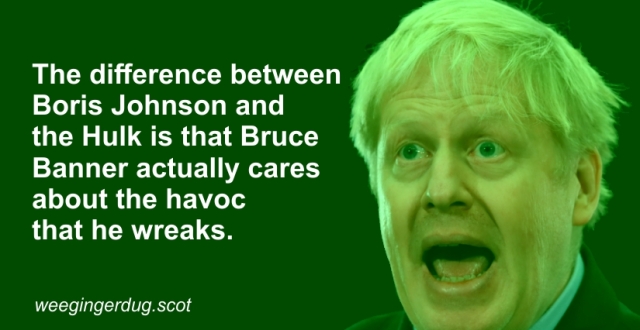
Hulk angry. Hulk ignore law. Hulk smash constitution. Hulk want no deal Brexit. Lyin Bastert Johnson has now compared himself to the Hulk, warning the EU that “Hulk always escaped, no matter how tightly bound in he seemed to be – and that is the case for this country.” Then he went on to add that the angrier the Hulk got, the stronger he became. We can only assume that the Prime Minister of the UK has been exposed to a heavy dose of gammon radiation which has fried his brain. I must have missed that Avengers movie where the Hulk negotiated a deal on the Northern Irish border and made phytosanitary arrangements that the EU could accept.
Of course there are some important ways in which LBJ does resemble the Hulk. Neither of them can keep their trousers on, both are out of control mindless destructive forces, and both inhabit fantasies. That’s where the similarities end. The Hulk always ends up regreting the damage that he wreaked when he went on a rampage. LBJ only ever regrets things that he feels won’t further his career or inflate his ego.
It’s a crucial week for the exercise in political convenience that passes for the British constitution. On Tuesday the UK Supreme Court is due to start making its decision on the ruling of the Scottish Court of Session that the Government’s prorogation of Parliament was illegal. The English High Court has ruled that the matter is not within the competence of the courts, and it’s up to the UK Supreme Court to resolve the difference between the two rulings. Not even the Hulk can smash the two together in a way that doesn’t overrule one of them.
One of two things has to happen. Either the Supreme Court will uphold the ruling of the Court of Session, or it will uphold the ruling of the High Court. It has to uphold one of them. If it upholds the Court of Session ruling, then Parliament will have been found to have been prorogued illegally and will start sitting again immediately. The Prime Minister will have been found to have lied to the monarch – even though it’s improbable to think that the Queen didn’t know exactly what LBJ was up to – and he will either have to resign or he’ll be impeached by Parliament. There will be an almighty constitutional crisis. English nationalists will be outraged that Scotland has overruled England. It will increase the resentment amongst sections of the Conservative party south of the border, and reduce their resistance to another Scottish independence referendum.
Alternatively, the Supreme Court will uphold the High Court’s decision that the matter of prorogation is a political one which the courts should not get involved in. If that happens it’s a dreadful blow for the Scottish legal understanding of the constitution. The Supreme Court will have ruled that the Scottish constitutional tradition no longer has any influence in the UK. That will be devastating to those who claim that Scotland has a constitutional voice within the UK. It will in fact be a decision that the UK is simply, in legal terms, Greater England. Scots law and constitutional tradition will have been determined to be subordinate to that of England.
As was pointed out by TT Arvind, who is a professor of law at York University, https://www.independent.co.uk/voices/boris-johnson-brexit-supreme-court-scotland-parliament-suspend-a9104446.html there is an important difference between the English Bill of Rights of 1689 and its Scottish counterpart the Claim of Right which was passed by the Scottish Parliament that same year. Both these documents are regarded as being foundation stones of the constitution of the UK, one operational under English law, the other under Scots law, yet the English Bill of Rights simply declares that “parliaments ought to be held frequently”, whereas its Scottish counterpart goes significantly further saying “parliaments ought to be frequently called and allowed to sit”.
The reason that the Scots Claim of Right goes further in asserting the right of parliament than its English counterpart is because in 1640 the Scottish Parliament had already asserted its right to sit after it had been prorogued by the monarch. Charles I prorogued the Scottish Parliament, and in a typically Scottish way the Scottish Parliament went “aye, right”, and sat in defiance of the king. While Professor Arvind stresses that the Claim of Right does not create legally enforceable rights as a modern law might, it is strong evidence that the Scottish constitutional tradition expressly rejects the right of the monarch, or a Prime Minister exercising the royal prerogative on behalf of the monarch, to prorogue Parliament against the will of Parliament.
Professor Arvind also points out that the English High Court cited the Parliament Act of 1949 as evidence that parliament could be prorogued for a political purpose. However there is a significant difference between the prorogation of 1948 and that carried out by LBJ this year. In 1948 the Labour government, which commanded a majority in the Commons, wished to pursue a programme of nationalisation of important industries. However due to the Parliament Act of 1911, the House of Lords had the right to delay bills for three sessions of parliament over two years. The Government was concerned that the Lords would use this power in order to block the nationalisation programme. In order to get their programme through, the Government decided to alter the Parliament Act so that the Lords could only delay bills for two sessions over one year. Since the 1911 Act carried a legal obligation to a delay over three sessions before it could be altered, the Government got around this with a extraordinary short session of parliament in 1948, with a King’s Speech on 14 September 1948, and then proroguing Parliament just over a month later on 25 October. That fulfilled the requirement of the 1911 Act.
The crucial difference here is that the prorogation of 1948 was carried out by a Government which commanded a majority of 146 and the prorogation had the aim of ensuring that Parliament could carry out its business without that business being blocked or prevented by an unelected upper chamber. Labour was elected in the first general election after WW2 with a mandate to introduce nationalisation and the National Health Service. The deeply reactionary upper house, which at that time was composed solely of hereditary peers, was viscerally opposed to this. The workings of democracy were facilitated by the prorogation.
This year’s prorogation has the opposite aim, it is to ensure that a Government without a majority can escape the scrutiny of Parliament and drive through a policy for which it has no popular mandate. While the Government can argue that it has a mandate to deliver Brexit, it is a minority government and therefore cannot legitimately act as though it can ram through whatever policy it likes as if it did have a majority. Certainly the government has no explicit mandate to deliver whatever form of Brexit happens to suit the political purposes of Johnson and his cronies. The Hulk is the strongest force in any room, Alexander Boris de Pfeffel Johnson’s Government is not the strongest force in the chamber of the House of Commons. The purpose of this year’s prorogation is to frustrate the workings of democracy. It’s more incredible sulk than incredible hulk.
Many English commentators are predicting that the Supreme Court will uphold the ruling of the English High Court and overturn the Court of Session. It does seem that many of these commentators are basing their predictions on the casual metrocentric assumption that Scotland is subordinate to England, we shall have to wait and see what the Supreme Court decides. However if the Supreme Court does uphold the High Court ruling, it will be a deeply alarming development. They will have ruled that the British Government does indeed have the right to suspend Parliament in order to escape scrutiny. If that comes to pass, then independence becomes a necessity in order to defend Scottish democracy itself.
 My new book has just been published by Vagabond Voices. Containing the best articles from The National from 2016 to date. Weighing in at over 350 pages, this is the biggest and best anthology of Wee Gingerisms yet. This collection of pieces covers the increasingly demented Brexit years, and the continuing presence and strength of Scotland’s independence movement.
You can order the book directly from the publisher. Ordering directly means that postage is free. You can order here –
https://www.vagabondvoices.co.uk/rants/barking-up-the-right-tree-2019
You can also order a book directly from me. The book costs £11.95 and P&P is an additional £3.50, making a total of £15.45. To order just make a Paypal payment to weegingerbook@yahoo.com, or alternatively use the DONATE button below. Please make sure to give me your postal address when ordering. Orders to be sent outwith the UK will incur extra postage costs, please email me for details. If you can’t use Paypal, or prefer an alternative payment method, please email weegingerbook@yahoo.com
You can help to support this blog with a Paypal donation. Please log into Paypal.com and send a payment to the email address weegingerbook@yahoo.com. Or alternatively click the donate button. If you don’t have a Paypal account, just select “donate with card” after clicking the button.
If you have trouble using the button, or you prefer not to use Paypal, you can donate or purchase a t-shirt or map by making a payment directly into my bank account, or by sending a cheque or postal order. If you’d like to donate by one of these methods, please email me at weegingerbook@yahoo.com and I will send the necessary information.
Please also use this email address if you would like the dug and me to come along to your local group for a talk.
 Gaelic maps of Scotland are available for £15 each, plus £7 P&P within the UK for up to three maps. T-shirts are £12 each, and are available in small, medium, large, XL and XXL sizes. P&P is £5 for up to three t-shirts. My books, the Collected Yaps Vols 1 to 4 are available for £11 each. P&P is £4 for up to two books. Payment can be made via Paypal.
